


There’s something both powerful and unsettling about needing a designated week to be visible. We see this a lot with pressing issues that require much more attention than just a week, such as Black Maternal Health Week, which just recently passed. Lesbian Visibility Week arrives each year with a necessary reminder: lesbians are here, have always been here, and are still—somehow—disappearing in plain sight.
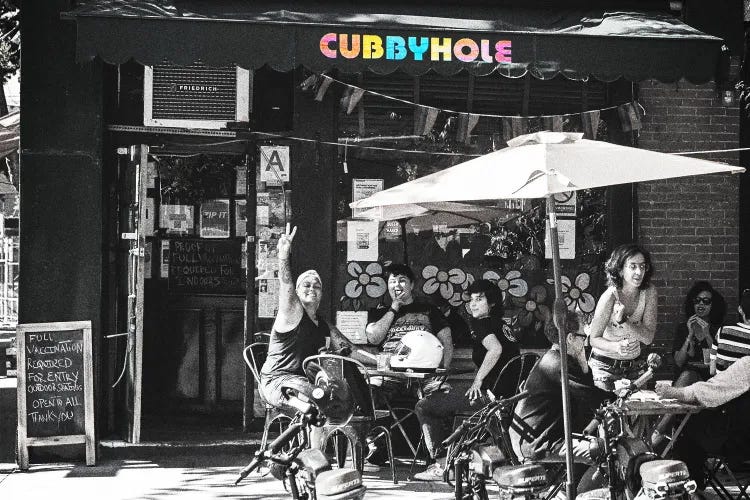
Visibility, for lesbians, has never been a simple matter of being seen. It is about recognition without distortion, presence without erasure, and community without fragmentation. While cultural shifts might suggest broader LGBTQ+ acceptance, lesbian-specific spaces, histories, and identities are increasingly at risk of being flattened, absorbed, and LOUDLY sidelined.
The Disappearing Space
One of the most tangible markers of this erasure are physical spaces. In the 1980s, the United States had an estimated 200 lesbian bars. Today, that number has dwindled to fewer than 30, which has increased from only 15 in 2019. The dwindling of these spaces is a huge cultural loss, because they’re not “new” or “trendy”—they have rich histories that prove the persistence and resilience of the lesbian community across time.
Lesbian bars are not just nightlife venues: they are sanctuaries. They are places where lesbians can exist without explanation, without translation, and without fear. In a world that often demands invisibility or conformity, these spaces offer something rare: ease.
The sharp decline is tied to a mix of factors: gentrification, rising rents, the rise of dating apps, and the broadening (and sometimes blurring) of queer spaces into more generalized LGBTQ+ environments. While inclusivity matters, it has also, paradoxically, contributed to the dilution of spaces specifically centered on lesbians.
What happens when a community loses its place to gather without negotiation?
Visibility vs. Assimilation
Lesbian identity has long been subject to reinterpretation, often by outsiders and within the broader queer umbrella. Increased media representation has not always meant accurate or affirming visibility. Too often, lesbian characters are hypersexualized, written for the male gaze, killed off, and/or positioned as temporary phases in narratives that ultimately center heterosexuality, and more specifically, men.
In a way to undercut lesbian relationships, many (mostly those in the manosphere or in conservative spaces) will refer to the statistic from a CDC survey stating 43.8% of lesbians reported having experienced IPV (intimate partner violence). However, upon further investigation, 72% of those 43.8% experienced violence at the hands of men.
Even within LGBTQ+ spaces, lesbian identity can be overshadowed. The expansion of language around gender and sexuality has been liberating in many ways, but it has also created tension around specificity. While the term ‘lesbian’ is traditionally defined as a woman attracted to another woman, modern definitions have expanded to “non-men loving non-men”, with broader terms like “sapphic” or “lesbian-identifying individual” used as more inclusive umbrella-terms for non-binary and trans lesbians. Within the lesbian community, there is still tension around terms, definitions, and the value of exclusivity–having places just for lesbians–because contrary to popular belief, you cannot tell a lesbian by their looks.
Visibility, then, has become complicated. As with many issues often overlooked due to white supremacy or heterosexuality, it is not about being included, but about being understood.
The Data Behind the Reality
Lesbian couples are statistically less represented in media compared to gay male couples, despite comparable population sizes.
Studies have shown that lesbian relationships receive significantly less screen time, and are more likely to be depicted as unstable or short-lived.
Lesbian women often face a dual marginalization: sexism and homophobia. This impacts everything from healthcare access to economic stability.
Community surveys continue to show that many lesbians feel underrepresented, even within LGBTQ+ advocacy spaces.
These are NOT abstract issues. They shape lived experience; how safe someone feels holding their partner’s hand; how easily they can find community; how often they see themselves reflected in the world around them.
Why Visibility Still Matters
It would be easy to assume that in 2026, visibility is no longer urgent. That would be a mistake.
Visibility is about young people having language for what they feel. It’s about ensuring that lesbian identity does not become a footnote in the broader story of queerness.
Weeks like Lesbian Visibility Week are not solutions, but signals. They point to what still needs attention, protection, and care.
Reclaiming Space, Reclaiming Narrative
There is, however, a quiet resurgence happening. New lesbian bars are opening in cities that haven’t had them in decades. Pop up events, collectives, and digital communities are carving out space where none existed before. Independent media is telling more nuanced stories. There is a deliberate effort, especially among younger lesbians, to document, archive, and celebrate their identities on their own terms.
Visibility, in this sense, is evolving. It is no longer confined to physical space, though that space remains deeply important. It lives online, in art, in fashion, in language, and it still requires intention.
Without intention, erasure happens gradually. Quietly. Until one day, you realize something that once felt undeniable now feels impossible to find.
Lesbian Visibility Week asks us to notice that — and to resist it.
Not just for a week, but every day.
*Fun Fact*
The shift of RuPaul’s Drag Race from Monday nights to Fridays (specifically starting with Season 9 in 2017) had a significant, disruptive impact on gay bars and, by extension, queer spaces like lesbian bars that often hosted viewing parties.
This article has been edited and approved by our humble lesbian supreme, Hannah 💅
Sources
Queering Place: The Case of the Lesbian Bar
There are only 15 lesbian bars left in the entire country. This campaign is trying to save them
What Happened to All the Lesbian Bars?