


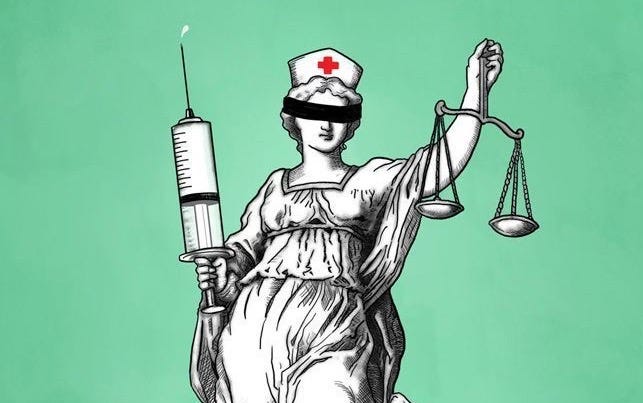
The last few times I’ve been in the hospital or the emergency room, I’ve had some horrendous experiences. And these were with multiple healthcare systems, including the big ones, like the Children’s Hospital of Philadelphia (CHOP), Virtua, and University of Pennsylvania (UPenn). Unfortunately, one thing that I’ve learned from these hospital and ER visits is that our healthcare system isn’t what it used to be.
I went to the ER at CHOP for an extremely bad headache. Now, you might be wondering why I’d go to a children’s hospital as an adult. Because I had an extremely rare brain tumor and was treated there as a child, I was eligible to go there upwards of 25 years old.
I was admitted into the hospital so doctors could figure out what was happening, and why nothing was helping my headache. My mom and I both begged the doctor(s) on my care team to give me an MRI, considering I’ve had two brain tumor resections and radiation for a brain tumor in the past (no one would). They kept insisting that I just had a migraine headache and that they were going to just treat me for this. I’ve never had migraines before, nor was the headache I was experiencing in any way indicative of a migraine. One day, after days of being in the hospital, the doctor came in while I was sleeping and tried to wake me up. My mom had told me that they tried to wake me up—and couldn’t. The doctor proceeded to take my vital signs, and when my mom cried out, “Can’t you see she’s not waking up, this isn’t normal!”, the doctor replied, “Oh, she’s awake, she’s just faking” (spoiler alert: I wasn’t faking). As we were telling a different doctor assigned to my care how frustrated we were that no one had ordered an MRI, especially as my symptoms had gotten worse since I’d been admitted, she replied that, “I’m not going to lie to you, you’ve been around long enough, and so have I—our healthcare system is broken. Doctors aren’t in charge here anymore. We have to follow standard protocol.”
I once had a neurologist from Penn tell me, “If you ever get a bad headache that won’t go away, call me before you go to the ER. I work for Penn, but our ER is a mess.” I recently found out how bad it was when I went for an endocrine-related issue. As we sat there waiting, we heard a nurse telling a patient in the waiting area, “Yes, I know we took your vitals earlier, but that was 4 hours ago; we need to retake them.” And as we were waiting to be called back, other patients who had been taken back earlier were being rolled back into the waiting room, on stretchers, with IV tubes hooked up to them. We finally ended up leaving after hearing one nurse say the wait was around 6 hours. I could go on with countless other traumatic stories of terrible things I’ve experienced in the ER and hospitals, but I’d be here all night. Every experience is the same; the doctors don’t listen. They don’t care. They have another patient to see, more money to make. They just do whatever standard protocol tells them to do.
I recently watched a documentary called Escape Fire: The Fight to Rescue American Healthcare. One doctor actually states, “If I spend five minutes with you, and then put in one of these stents, I would get paid $1500. For me to spend forty-five minutes with a patient, and try to figure out what their true problem is, I would get paid $15.” This quote, sadly, only proved there was truth in what the doctor admitted to us. Doctors aren’t paid anymore to actually do their job—they are paid to meet quotas for the big healthcare corporations they work for. They are taught standard protocols to implement for every patient they see. During one of my hospital stays, I had written a poem, containing this line, “These doctors don’t listen, these nurses don’t care. It feels like they just try what works for everyone else, as if they don’t even realize I’m lying here.” At the time, I hoped I was just being dramatic, but as I’ve experienced more and more of the same, I’ve realized that this is, in fact, reality.
According to this same documentary, “30,000 medical recipients die every year in America, from care they didn’t need. That’s the equivalent of a jumbo jet crashing every week.” One doctor in the documentary makes such an excellent point, stating, “If the aviation industry killed as many people, we’d be up in arms.” It is so true that if any other industry killed 30,000 people per year, it’d be all over the news, and there’d be protests and riots. Instead, because it’s the healthcare system, we say that they were just trying to help, and push it all under the rug.
Yet, are we closing our eyes to reality? You see, the healthcare system isn’t aimed at helping people anymore; it’s aimed at making the healthcare industry richer. The U.S. spends a much higher amount compared to other countries on healthcare (16.5% of its GDP), and yet ranks last in overall healthcare, access to care, and health outcomes, when compared with ten other countries. One analysis reports that the US spends 16.5% of its GDP on healthcare—4.6% more than France and 4.8% more than Switzerland, the next two biggest spenders. However, out of the ten countries this analysis compares, the US ranks last in overall healthcare, access to care, and health outcomes (Blumenthal, Gumas, Shaw, Gunja, & Williams, 2024).
I don’t understand the point of spending so much on a healthcare system that ranks dead last in overall healthcare. Where is all of that money going? Certainly not toward bettering the health of the people of our country, or paying to be able to hire more healthcare workers. No, it’s going right into the fat pockets of the big corporations. Rather than paying more doctors, hospitals are encouraging the doctors they do have to up their productivity. In other words, the more patients they see, the more they get paid. This is why we’re seeing things like boarding in emergency rooms. The College of Emergency Physicians President stated, “Boarding is when a patient remains in the emergency department, even after a disposition has been made in terms of what their care should be, sometimes even for days and months and weeks.” (Rascoe, 2023).
The same article noted how many people now go to emergency rooms because of the lack of access to care our nation has. So people are going to the ER for anything and everything. The emergency room has now become a safety net for those without insurance or healthcare access. “Essentially, we are the jack of all trades, if you will, and we’re there 24/7 to care for patients. The problem with boarding is that it’s really interfering with the inherent function of the safety net, because when we can’t move patients, essentially the whole system backs up. We just don’t have physical space. So, we find ourselves literally going into the waiting rooms to take care of patients from there or taking care of patients in the hallway.” Doctors are so rushed in trying to take care of everyone at once, trying to up their productivity to meet their organization’s quotas. They don’t have time to actually care about helping their patients anymore. If healthcare professionals actually treated patients, then the healthcare industry would stop making money. Shouldn’t healthcare have a lot more ‘care’ in it? Is our country so brainwashed into thinking that faster is better—that we believe we’re actually receiving the best healthcare—when in fact the opposite is true?
Edited by Isabelle Hampton-Zabotti
Sources:
Blumenthal, D., Gumas, E. D., Shaw, A., Gunja, M. Z., & Williams, R. D. (2024, September 19). Mirror, Mirror 2024: A Portrait of the Failing U.S. Health System: Comparing Performance in 10 Nations. The Commonwealth Fund. https://www.commonwealthfund.org/publications/fund-reports/2024/sep/mirror-mirror-2024
Rascoe, A. (2023, June 25). The COVID-19 emergency is over, so why are hospital emergency rooms still crowded?. NPR. https://www.npr.org/2023/06/25/1184198834/the-covid-19-emergency-is-over-so-why-are-hospital-emergency-rooms-still-crowded#:~:text=According%20to%20NPR%2C%20emergency%20rooms%20are%20still,Lacerations%20*%20Orthopedic%20injuries%20*%20Broken%20bones
YouTube Movies & TV. (2012). Escape Fire: The Fight to Rescue American Healthcare [Video]. YouTube.
