


There are parallels between parts of Asia and America in regards to being homophobic, patriarchal, and capitalistic. Mark Chiang’s “Coming Out into the Global System: Post Modern Patriarchies and Transnational Sexualities in The Wedding Banquet” focuses on these facts relating to the film The Wedding Banquet. Released in 1993 and Ang Lee’s second film, this film was seen as part of an almost “trilogy” with two of his other films: Pushing Hands (1992) and Eat Drink Man Woman (1994), as they all focused on “intergenerational conflicts in Chinese families” and star actor Sihung Lung in all three films (Encyclopaedia Britannica). Unlike the other two films, The Wedding Banquet focuses on a mixed race homosexual couple, Gao Wai-Tung and Simon. This relationship reimposes David Eng’s remark in David Chiang’s article that “Asian gays involves many irreconcilable choices between aligning oneself with a predominantly white fay community…” (Chiang) in Manhattan, New York City. As Chinese immigrant Gao Wai-Tung, is in a domestic relationship with White American Simon.
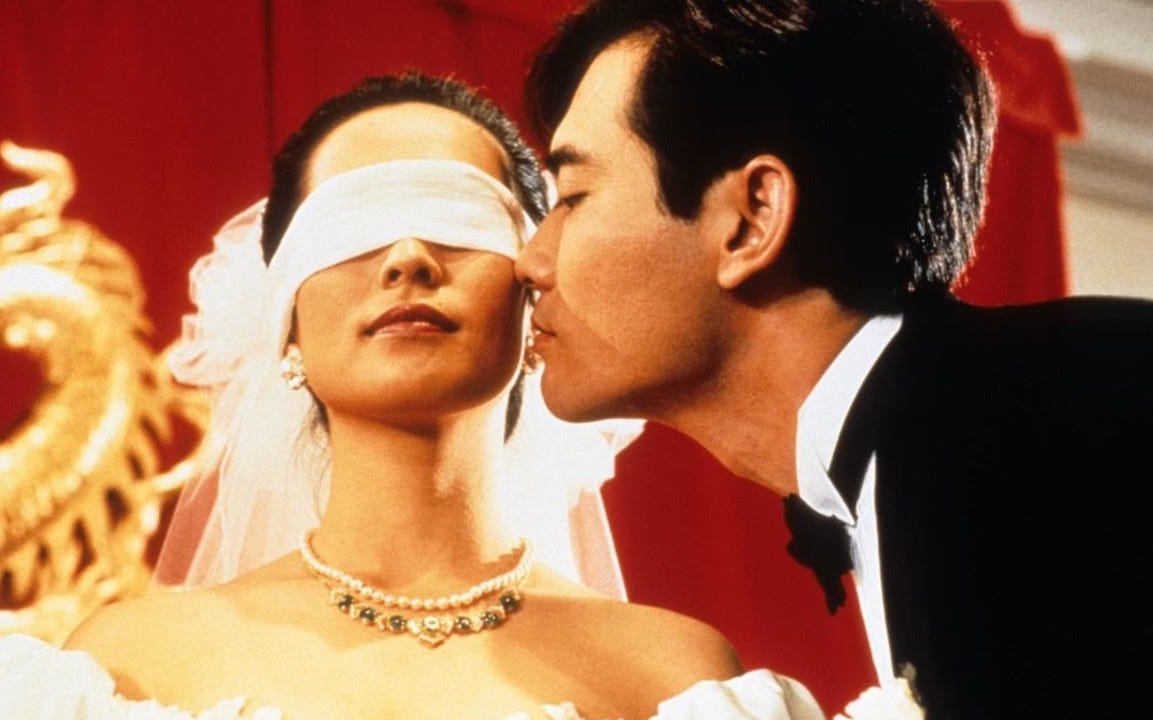
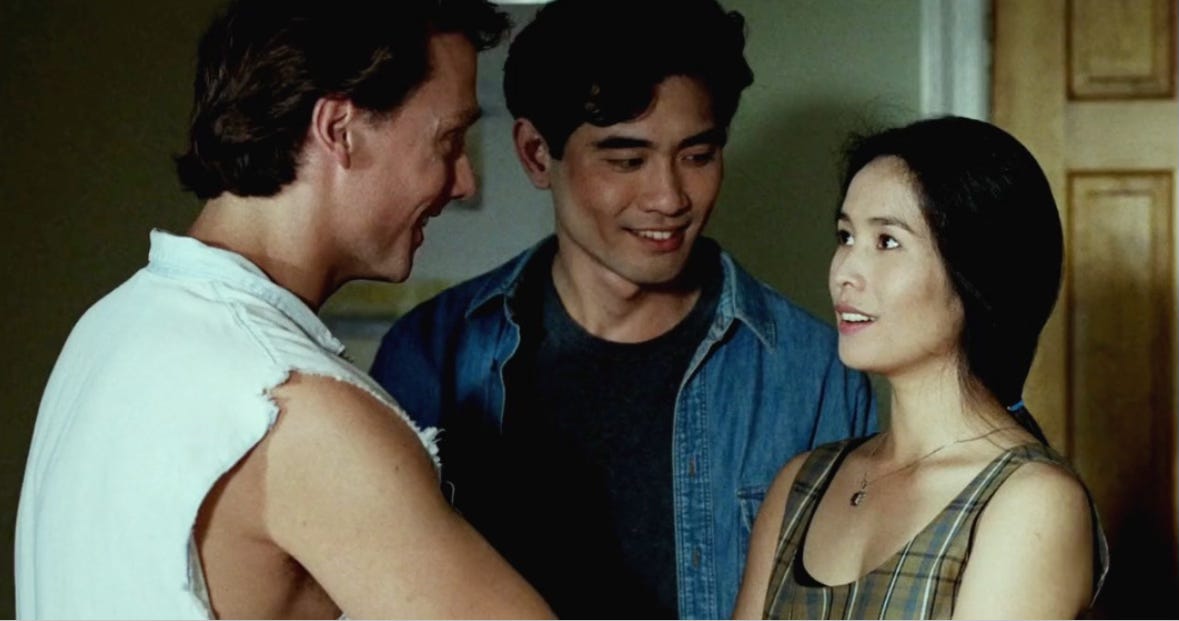
As Wai-Tung realizes that his father is having serious health issues, he decides to fake a marriage with one of his tenants, Wei Wei. She is a Chinese immigrant painter in need of a green card to stay in the United States. As his family arrives in the states, and this said trio’s fake marriage, their lies, secrets, and patience start to wear thin on each other as the parents deal with more health scares, truths, and disappointments. Chiang describes the film as an open space for “gay people in homophobic Asian and American communities…it also calls to mind the co-optation of the gay male in the reconstruction of Asian patriarchy” (Chiang). Lee’s film, The Wedding Banquet, shows how the characters use performative heterosexuality to maintain power, most notably through the directorial choices of lighting and music that show the instability that the characters experience as they lose the power that they once thought they had.
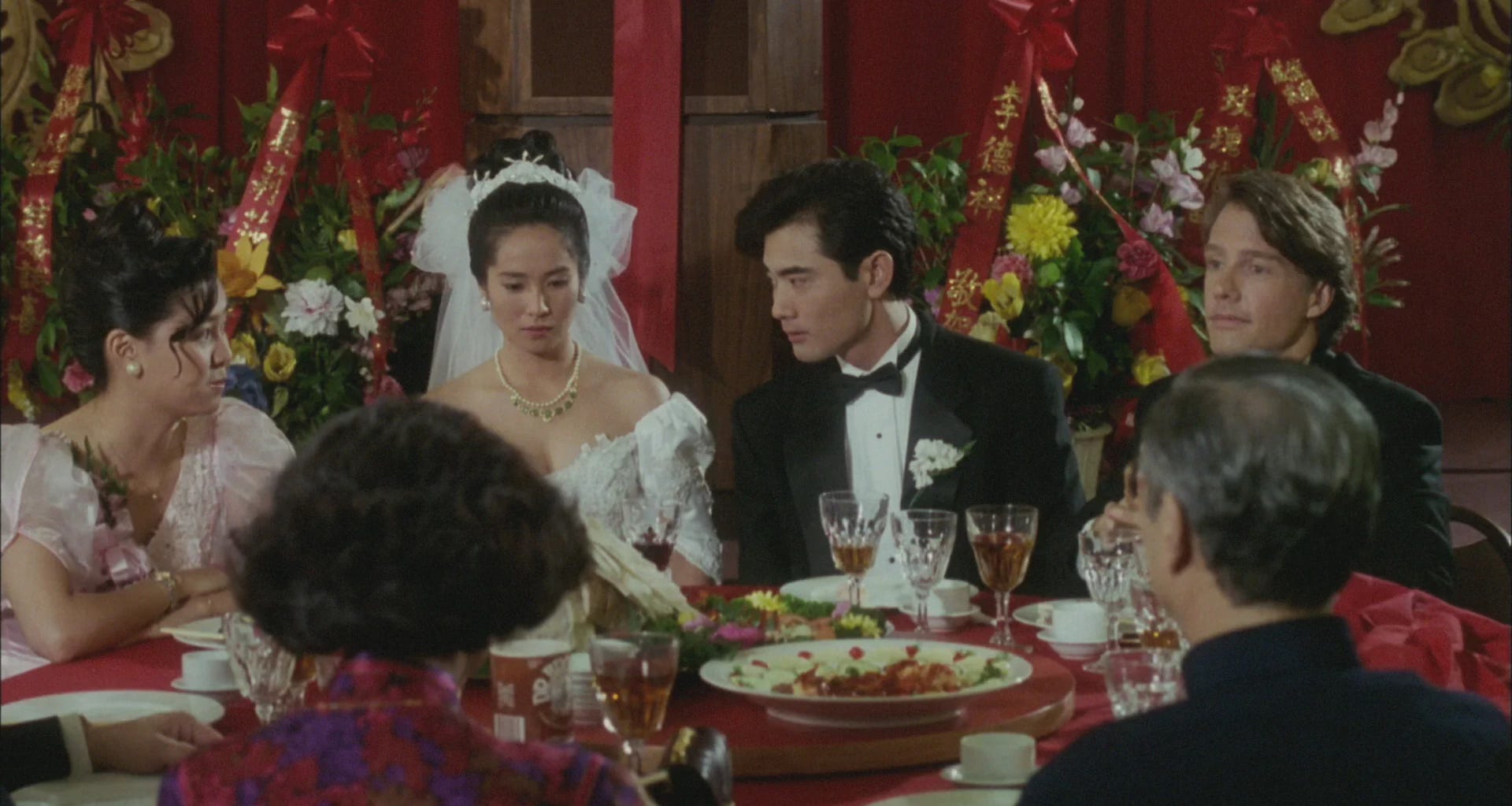
Lee chooses to show who is lying in a different way than normal directors do. Throughout the film he puts a focus on who is lying in the family and is burdened by the secrets from the performative heterosexuality that many of them display by keeping them out of focus or darkened while in frame. One scene that relates to how someone is lying is the scene after Wei Wei and Wai-Tung’s courthouse marriage. In this scene Wei-Wei, Wai-Tung, and his family are walking forward as Simon rushes in front to take a photo of all of them together, Simon is in complete shade and darkness compared to the other characters. Simon is the secret that Wei Wei and Wai-Tung are keeping. He is Wai-Tung’s boyfriend and rightful partner, where Wei Wei is not. Compared to Simon, Wei Wei (also in the front of the group) is completely lit up, because she is the hope for all the characters. The beard to help Wai-Tung and Simon conceal their relationship from Wai-Tung’s family and present the hope for a grandchild for Mr. and Mrs. Gao. She holds hope and secrets in her hands, theoretically holding all the power within the parties. (The Wedding Banquet, 40:33).
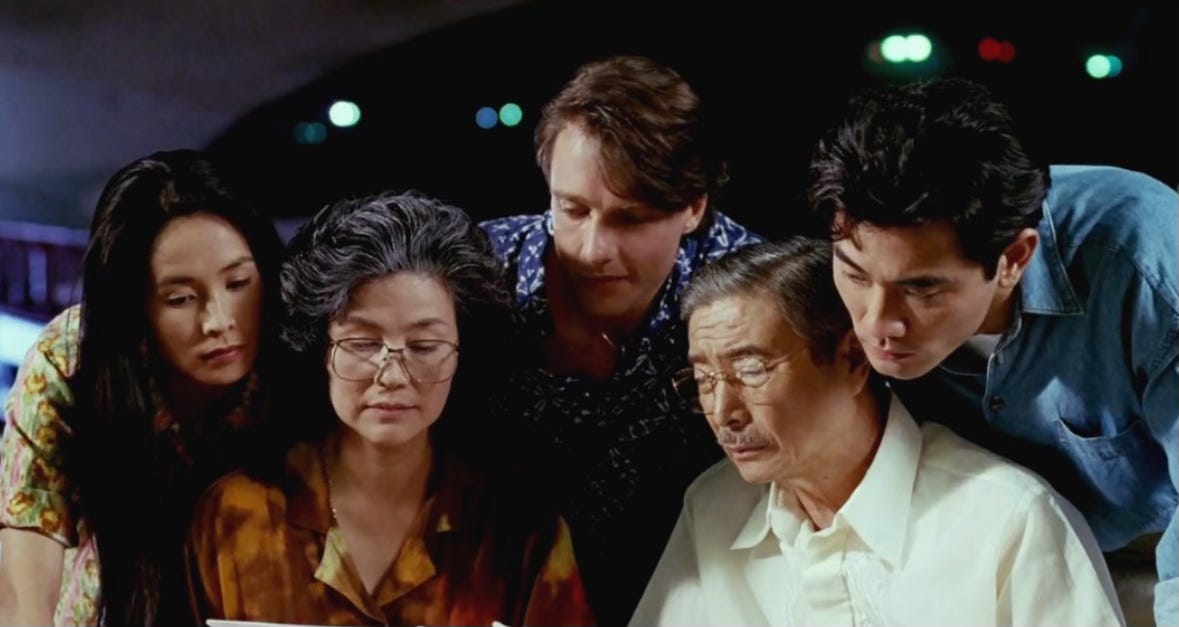
Wai-Tung and his father on the other hand are shadowed on one side each, the side that faces Mrs. Gao and each other. This can be theorized to be a visual representation of their lies to each other. The side of which Simon is on is lit up for Wai-Tung, because Simon knows his secrets; he is not being lied to. While Mr. Gao’s lit up side is to a wall because at this point in the film, no one, not even the audience, knows the secret he is keeping. At 40 minutes 38 seconds, just 5 seconds later, we see Wei Wei completely covering Mrs. Gao in darkness. Mrs. Gao’s power as the matriarch of the family is now being replaced by Wei Wei, ultimately making Mrs. Gao obsolete in the care of her son (The Wedding Banquet, 40:33).
Earlier in the film, we see that Mr. and Mrs. Gao are shrouded in darkness in the car upon the first time being in America to see his newly betrothed son and daughter-in-law-to-be. The darkness on their faces is almost a little too literal in sense, because in this portion of the film, both of them are completely in the “dark” about the truth of their son and his “marriage.” They do not start to be shown in light until Wei Wei continues to explain about her family: the only truth they have heard so far in the film. (The Wedding Banquet, 25:27).
Ang Lee’s choice in music with the artist Mader, also helps show how performative the characters feel they need to be and the anxieties that come with it. In the same scene in the car when the parents are picked up by Wai-Tung and Wei Wei, a more “mysterious” roll of the song “Ma & Pa Arrive” at 2 seconds as the Mr. and Mrs. Gao look at each other knowingly and concerningly because Wei Wei is from the “mainland” of China (The Wedding Banquet, 26:00). This shows their own anxieties with the fact that Wai-Tung is marrying a Chinese girl, instead of a Taiwanese girl. Taiwan and China have been at odds for centuries due to China believing they own Taiwan and Taiwan wanting independence. Letting Wai-Tung marry Wei Wei and accepting her within the family gives up a lot of the power they sought to have as traditional Taiwanese citizens. This was further shown that this scene happens right after they mention a tradition they have towards the parents of the bride that Wei Wei ultimately dismisses.
Later, in the same song, a more jazz sound starts up with a trumpet playing at a more anxious pace as we see Simon hurrying to make food for the family and rushing to the door, while also taking off his earring. This scene is important, because it shows a hurriedness in Simon to make sure everything is perfect. The song, the food, the earring; it all gives to the performance that Simon is playing for the guests that don’t even see him yet. The jazz of the music makes this feel more like a dance as well as a welcoming. (The Wedding Banquet, 26:12).
Throughout the film, Mader chooses to mix in more traditional Chinese influences into the music. During really critical points of the film Mader chose to have more of a traditional sound playing, like “The Boiling Point” during multiple scenes: when Wei Wei drunkenly takes advantage of Wai-Tung (1:08:55) or during Wei Wei’s shower scene where she ultimately realizes that she is pregnant (1:13:37). These two scenes are pivotal to the story and around times when something big is happening for Wei Wei and Wai-Tung together when no one is looking, and Wei Wei still makes Wai-Tung put on a heteronormative performance, even though she does know the truth. These are also instances that Wai-Tung has no power at all, even though he is the man, he has unwillingly given control to Wei Wei.
The final kind of music that Mader chose to include, is music mixed with his rhumba and Chinese accents. His song, “Rhumba (end credit)”, at the end of the film mixes both of the sounds we hear throughout the film and this scene also shows a mixing of cultures. With Simon, Wei Wei, and Wai-Tung all shown as finally happy. Simon has been given Mr. Gao’s blessing to be with Wai-Tung, Wai-Tung is out to his mother and has made his father proud by giving him a grandchild, and Wei Wei has a family that will be there for her and a green card so she can stay in the states and be a painter.
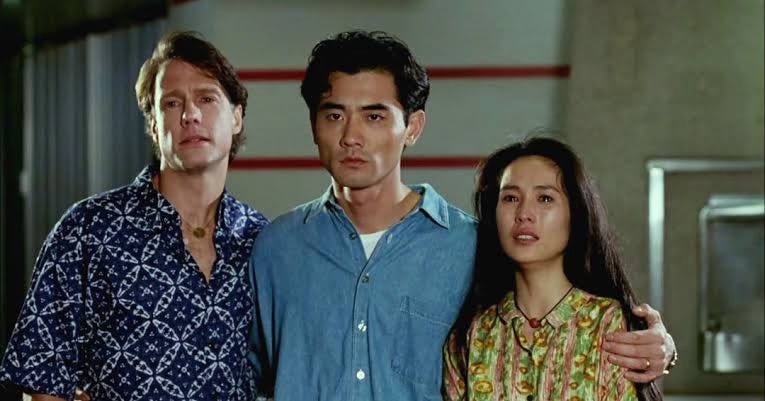
The Wedding Banquet (1993) is a film that takes intergenerational relationships between two cultures and tries to find common ground between them. Ultimately, at the end of the film, they all realize they had lost the power they so desperately were trying to stay hold of with the lies they were telling each other and got the happiness they wanted when they finally started telling the truth. The only character to have seemed to have genuinely gotten everything and held power the entire time is Mr. Gao. Mr. Gao held all the power throughout the film, except over his own body. He’s dying, he is having strokes, and he is in hospitals, which is why any of this happens in the first place. The lack of power each character holds is nicely shown with Ang Lee’s choice of lighting and music. The anxiety, lies, and deceit are why they all are miserable throughout the film.
Works Cited
“Ang Lee.” Edited by Encyclopaedia Britannica, Britannica Academic, 2025.
Chiang, Mark. “Coming Out into the Global Systems Postmodern Patriarchies and Transnational Sexualities in The Wedding Banquet”, Q & A: Queer in Asian America. 1998, 374-395.
Mader. “Mao / Photos.” The Wedding Banquet (Original Motion Picture Soundtrack), 1993. Loon Music
The Wedding Banquet. Directed by Ang Lee, Bleeker Street Media, et al. 1993
Edited by Isabelle Hampton-Zabotti
