


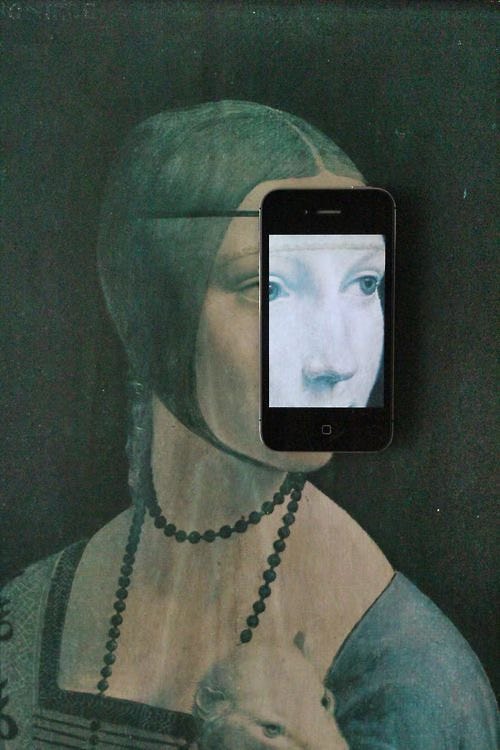
Digital art surged in popularity with the launch of Photoshop and the boom in personal computer use in the 90s. Nowadays, digital tools such as Procreate or Blender offer an easy entry point for any artist with a laptop or phone who cannot afford to spend hundreds of dollars on materials. Over the past few decades, mixing mediums has become more accessible than ever, and, as a result, art has become more integrated with social media.
This merging of creation and consumption brings both benefits and drawbacks. To explore these, I reached out to several North Florida-based artists for their unique perspectives. Max Elton, a digital artist, illustrator, and designer, operates a beautiful Instagram page and Etsy shop, where he showcases nature-themed work. Amanda Boekhout Diefenthaler—also known as divinefem—is an artist, mother, wife, and teacher who creates multimedia works centered on the spiritual realm. In the center of Tallahassee, the Venvi Art Gallery displays local talent while targeting a more corporate market to attract buyers. Together, these viewpoints form an intriguing picture of how social media has reshaped artists and their art in Tallahassee, a city not typically seen as a major arts hub.
Increased Accessibility
Embed:
Social media enables artists to circumvent limitations in location or gallery accessibility by providing global reach. This can be especially helpful to Tallahassee artists because it doesn’t limit them to local events and markets that often don’t drive large crowds. Instead, an artist could post their work for hundreds to see in just a few minutes.
“Once I started using social media to promote my art, it helped my reach as an artist immensely, and I was able to get many opportunities I wouldn’t have been able to get without the help of social media,” Max Elton said.
Artists can now sustain a career without relying on physical exhibitions. This is evidenced by Elton’s successful Etsy page and Diefenthaler’s comprehensive website, which features products ranging from art prints to yoga courses. This success stems from the positive impact of social media algorithms, which direct users to artists and works they are likely to resonate with and consider purchasing.
“Instagram has definitely expanded my reach, and in turn, I have sold more art without having to constantly have gallery art shows,” Amanda Boekhout Diefenthaler said. “It has invited an alignment with people who resonate with me. The audience changes all the time as I evolve with my work.”
The Algorithm Trap
Embed:
Most social media algorithms learn which types of content users interact with. They then push more of that content to keep users on the site for as long as possible. While this feedback loop can positively affect artists by directing their work to potential fans, it can also keep users away from content the platform deems “not eye-catching enough.” As a result, many Instagram-based artists feel forced to adhere to trends and prioritize virality over what they truly want to create. This constraint hinders artistic freedom and unrestrained expression.
“Social media does have its downsides,” Elton said. “It can be hard when you just want to post your art, but you also have to consider social media algorithms.”
There has been a substantial shift in the composition of artists on social media over the past decade. What began as a relatively simple way to build a niche community around one’s work has now become a gladiator-style fight for views and engagement as platforms shift from social networks to interest engines: systems focused on exploiting the user’s engagement habits rather than connecting them with pages they’ve connected with. If your post doesn’t fit into the engine, it may not even be pushed to your followers.
This instability has taught Diefenthaler the importance of not becoming consumed by the numbers. The content that is popular now may not be a few years from now, so there is no point in getting hung up on what is appealing over what one is passionate about creating.
“I’ve been on IG as @divinefem for 12-13 years. It’s changed a lot, and my relationship with it has changed along the way. I had a phase where I was drinking the Kool-Aid and trying to work the algorithm,” Diefenthaler said. “I found that prioritizing the ever-changing ‘rules’ of socials took away from my connection to my creativity. IG is fun and inspiring, AND I am not going to rely on an app to build my art reach. It could change, crash, or disappear anytime.”
Limits of the Screen
Embed:
Walter Benjamin, in “The Work of Art in the Age of Mechanical Reproduction,” defined aura as the authenticity, history, and presence an artwork acquires from existing in a particular time and place. This idea introduces tension when we consider how art is often consumed online, confined to a small, pixelated screen. On a screen, the viewer loses connection with the work’s aura, a quality preserved in a gallery, where every brushstroke, color, and layer can be fully appreciated.
“Venvi Art Gallery was established well before social media became central to how people discover art. As social media evolved, it became a complementary tool rather than a replacement for the gallery experience,” manager Rachel Smith said. “Social media has expanded our reach beyond the gallery walls, allowing people who may never physically visit Tallahassee to become familiar with our artists and exhibitions. However, our curatorial approach has not changed; we still prioritize depth, craftsmanship, and the work’s physical presence. Social media supports visibility, but the art itself continues to lead.”
Given these dynamics, the role of social media for artists needs to be balanced. Letting engagement and input take over can leave an artist dissatisfied, feeling bossed around by the algorithm. On the other hand, refusing to use social media means sacrificing access to a massive audience that might view, share, or even purchase art if they saw it in their feed.
“Before IG, my art was created to be experienced in person, in real time. I love that I had so much time without social media being a part of the art-making process. It felt more raw and ephemeral,” Diefenthaler said. “It’s so powerful to be with art in real life. The little screen on a phone will never do art proper justice.”
A Tool, Not a Master
Social media and its unstable algorithms can be used as a tool, but they cannot be viewed as the master of one’s art. It can foster rapid growth and enable art consumers to discover a distinctive style with which they will connect deeply.
“Yes, social media has contributed to the growth of the gallery, particularly in visibility and accessibility. It has helped us reach new collectors, artists, and collaborators who discover Venvi through shared images, exhibition highlights, and behind-the-scenes moments,” Smith said. “Growth has come not from volume, but from meaningful connections formed through consistent storytelling and presentation.”
Social media provides diverse revenue streams for artists: direct-to-consumer e-commerce, print-on-demand merchandising, brand partnerships, commission-based services, and ad revenue. Not every artist utilizes these devices, but they are present for those who need an extra boost in clientele, as seen in the experiences of all the artists I inquired with.
“There have been times when sharing on socials resulted in a lot of art sales. I would say financially, I have pretty similar results every year with slow and steady growth,” Diefenthaler said. “I don’t really consider my art a business. It’s my life.”
Social media has transformed art making and sharing—offering powerful opportunities but also introducing challenges to creative freedom and authenticity. Overall, social media is best used as a funnel leading people to engage with heartfelt work and find artists they wouldn’t find otherwise. Still, it doesn’t hurt to visit your local art galleries and absorb what is right in front of you.
“Social media may introduce an artist, but a gallery provides context, credibility, and a curated environment where the work can be fully experienced. Many visitors come in already familiar with an artist’s work from online platforms, yet their understanding deepens when they see the scale, texture, and emotional presence of the artwork in person,” Smith said. “Rather than competing with social media, we focus on offering what it cannot: thoughtful curation, dialogue, and the lived experience of art in space.”
Edited by Natalli Marie Newman
