


Courtesy of Zawyeh Gallery
In our world today, the ‘anxious artist’ stands alone, confronting multiple destinies, as his own self appears as a broken machine, spinning restlessly like a swirl in a hopeless attempt to piece together its fragmented parts.
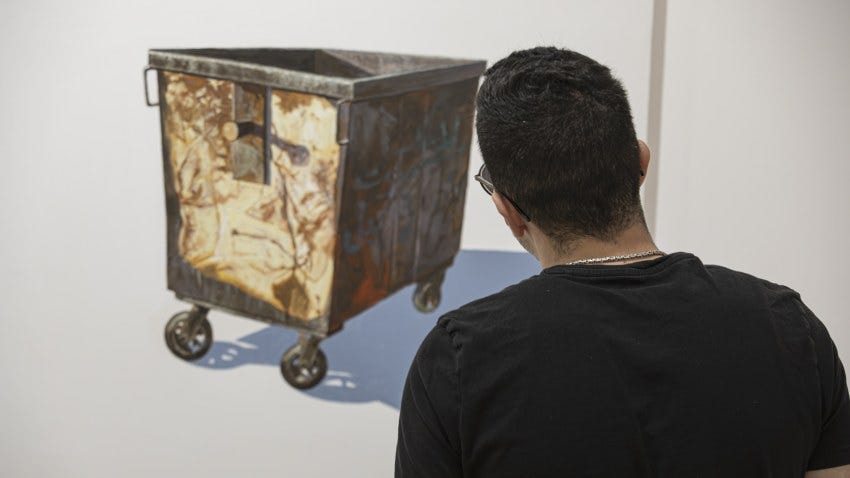
1 The Field of Dreams is an exploration of formations of ‘steel’ in the public space from the perspective of the relationship between the self, the object and the other.
It can be viewed as an interactive space with the fragile reality in which humanity lives. Artist Bashar Khalaf creates an ambiguous dialogue with accumulated ‘steel’ by employing several dry and liquid media. He uses oil colours in two series of artworks: Junk Garden and Protective Shield; charcoal on paper in the series Alhisbeh Fire; and plastic acrylic colours that hint at the relationship of all these elements with place through the series WeRamallah.
In a complex language, Bashar Khalaf confronts us with the dilemma of the present, not with the goal of transcending it, but of comprehending and understanding it. In fact, this state of contradiction possesses an exceptional ability to fix our gaze upon the era in which we live, focusing on its most ambiguous aspects. This is the essence of the thinking of the ‘contemporary’ artist who, as Giorgio Agamben describes, ‘firmly holds his gaze on his own time so as to perceive not its light, but rather its darkness’ (Agamben, 2009, p. 44).
The matter may appear confusing when we ask: What drives Bashar Khalaf to fix his gaze on the sites of fracture in the present? And what is their relationship to other temporalities: the past and the future?
The appeal of the artworks in The Field of Dreams lies not only in the diversity of their approaches, but arises primarily from the varied gestures they contain and the ways in which these gestures affect one another. The exhibition’s central problem thus appears complex, unfolding across three interwoven levels. The first dismantles time within a ‘memory archive’, classifying it into past and future while affirming the centrality of the present. The second is grounded in Bashar Khalaf’s own self: how he views society and objects, and the local questions that branch out from them. The third is connected to global repercussions and their effects on humanity’s future.
Under objective conditions, these levels converge at sites of ‘fracture’. At their core, they draw their philosophical depth from a troubled preoccupation experienced by Bashar Khalaf in a world of mirrors opening onto themselves. This preoccupation produces no answers; instead, it generates endless questions and drives a breathless pursuit of an understanding of the complex relationships between the individual and the self, society and objects: how might these relationships be perceived, re-presented and communicated to others in exhibitions? This circular ambiguity constitutes a frightening departure from the present despite living within it; in other words, a multiplicity of external and internal perspectives.
Accordingly, the operation of darkness surrounding The Field of Dreams is manifested in its capacity to document the world as it is today in both its private and public dimensions, with its frail structure and collapsing formations. The symbols of doubt presented by Bashar Khalaf centre on what is shared and what remains contested. The flow of darkness spread by the paintings thus points to the paralysis of the present and its dissolution into two simultaneous axes - the past and the future. This is the essence of the vision that Bashar Khalaf seeks to embody through his works in The Field of Dreams.
2 The Archaic Appearance in Junk Garden: The Machine
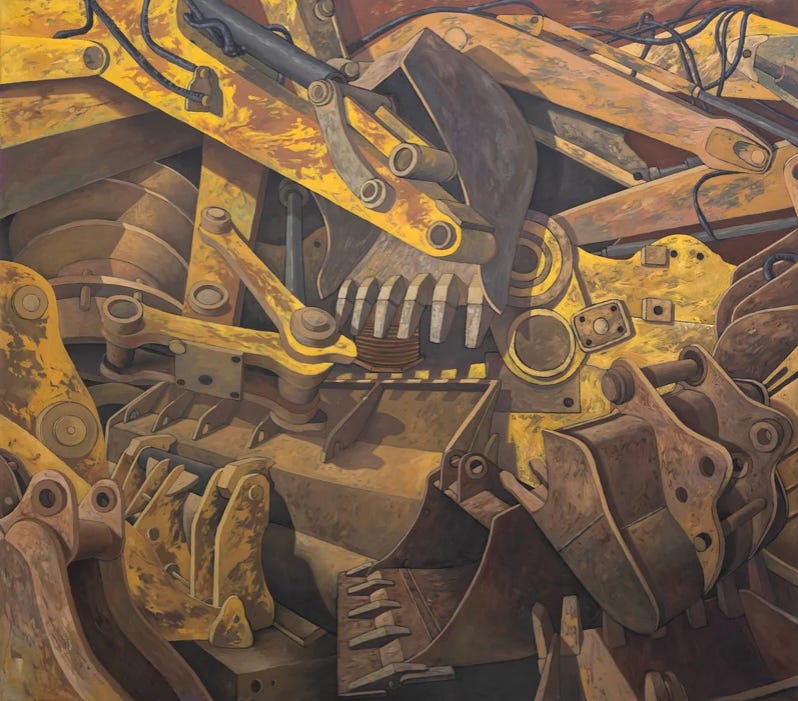
The Field of Dreams, or dreams as minefields, is nothing more than the dysfunctional and non-operative dreams of ‘junk’. They remind us of their dynamic state, the unavoidable multiplicity of their possible outcomes and their subordination to the modern, brutal and dominant structures that govern forms of life. The conceptual paradox lies in granting the energy of dreams to bygone ‘steel’ structures - bulldozers, vehicles and surveillance cameras - giving them an immense power to reinvent themselves and generate their own symbols for understanding the world.
We witness the shattered ‘machine’ losing itself in the chaos of its struggle with destiny, much like a war in which power crumbles before the energy of scrap metal to reveal and portray the true face of the world. The machine is confronted with its own existence, given a tragic form and drawn into a profound engagement with the cycle of time, as though repositioning itself differently in relation to the world and others. This proximity to ruin - made visible in Bashar Khalaf’s atemporal images of shattered bulldozers, exhausted vehicles and other forms - accompanies the old in its sorrowful decline, allowing it to see itself anew and return to us once more, but in a distorted, fragile and painful form.
What, then, makes isolated junk carry all these meanings?
Its inwardly submerged structure enables it to say so much. The machine, with all the vitality and authority it once possessed, acquires a particular artistic appeal through its cessation and the chaotic entanglement of its parts. This offers a profound expression of our divisions and distortions. Despite steel’s rigid formal structure, scenes of disintegration are the most prominent: objects appear to be collapsing, their sides filled with gaps and cracks that reverberate within us.
Bashar Khalaf treats his internal forms according to this mode of ordered chaos. The paintings in the Junk Garden series are built through a density that occupies the entire surface of the canvas, in an attempt to describe, on the broadest possible scale, the extent of the fragmentation caused by ‘the machine’. The immense power acquired by machines has made the world more fragmented than it should be, until it appears crowded with shards: human and material, chains, mechanical arms, wheels and nerves. Here, art composes the fragments in a form that is fragile yet dense. This abandonment of the old form expresses, in its substance, society and its dysfunctional relationships in the processes of producing and reproducing life.
3 Protective Shield: The Fusion of Memory
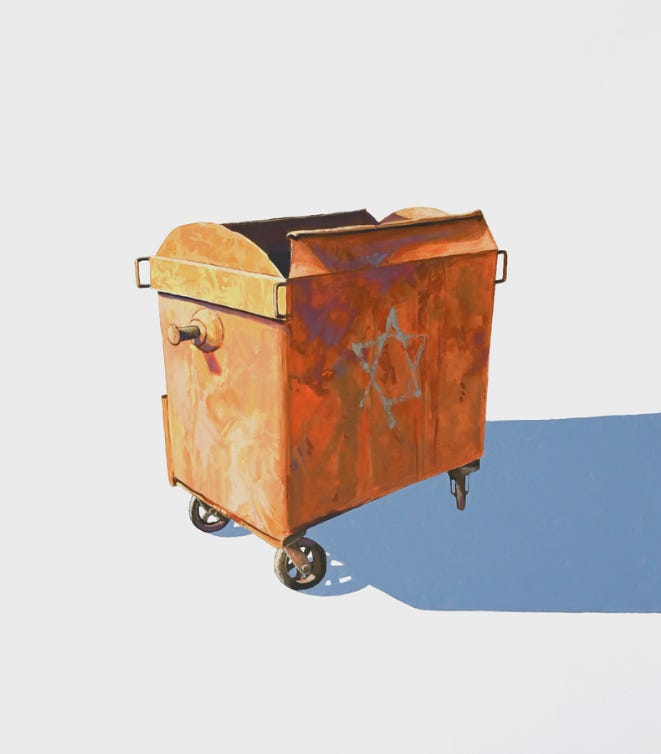
In Protective Shield, Bashar Khalaf emphasises his paradoxical dialogue through depictions of ‘garbage bins’, highlighting their multifaceted role during the First Intifada. They were used to block streets, stopping the advance of the colonial-settler war machine in Palestinian cities and providing shelter from bullets during confrontations. In contrast, the colonial system used steel barrels filled with cement to seal off the entrances to villages and refugee camps, aiming to besiege and isolate Palestinians.
Within this horizon, the paintings of Protective Shield expand to encompass most of the details of the Palestinian uprising, with its dreams and its pains. Yet a blind zone is embodied in the shadows around and within the containers: dark pits that unsettle the scene, where the observed and the unobserved become entangled. How can we avoid staring into the pit when it lies before our eyes in all its darkness, extending into an infinite depth? This leads us to ask: What is Bashar Khalaf looking at?
The gaze directed into the pit produces a mounting ambiguity. Although densely static, the ‘abandoned’ container, emptied of waste, exchanges gazes with us. It confronts us and imposes its presence with absolute parity. It stares in turn and shifts its position, form, content and possible fate, confronting us with questions: Where have we arrived after all these years of political settlements? How were dreams of an ordinary life, like those of other peoples of the world, shattered? And when will this pain, accumulating from the Nakba to the present day, come to an end - this present in which our fractures meet?
Between the two series, Junk Garden and Protective Shield, Bashar Khalaf takes us towards this crumbling form and places us at the centre of a vortex. He deliberately submerges ‘steel’ within its own parts and recurring images, driven by the personal transformations accumulated in images of his past.
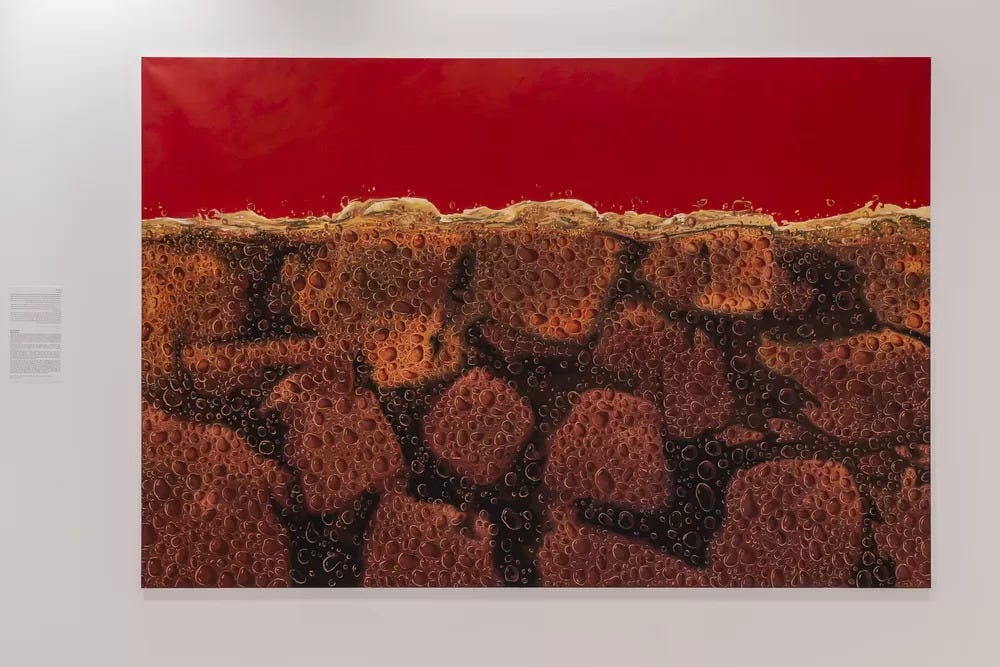
4 Symbols of Capitalism: Coca Cola
Our present age is marked by escalating consumerist impulses, alongside tendencies towards domination and control, and by the continued exploitation of natural resources with unparalleled brazenness despite growing evidence that these resources cannot withstand such exploitation. The world as we live it is shaped by profound global transformations in economics, politics and culture. It can no longer be understood without examining its divisions: it is no longer governed by a single logic, but is instead characterised by multiple centres.
Contemporary capitalism may be pushing societies to the brink of the abyss because of the harsh ideology it embodies. Here, I find myself in agreement with Fernand Braudel, who describes capitalism as a product of inequality in the world and argues that, in order to grow and spread, it requires the complicity of the international economy. He presents it as the offspring of an authoritarian organisation whose sphere undoubtedly extends beyond all bounds, and which could not have advanced with such momentum within a limited economic space (Braudel, 2008, p. 77). This is connected to capitalism’s need for a ladder made up of societies, enabling a small number of people to reach its summit.
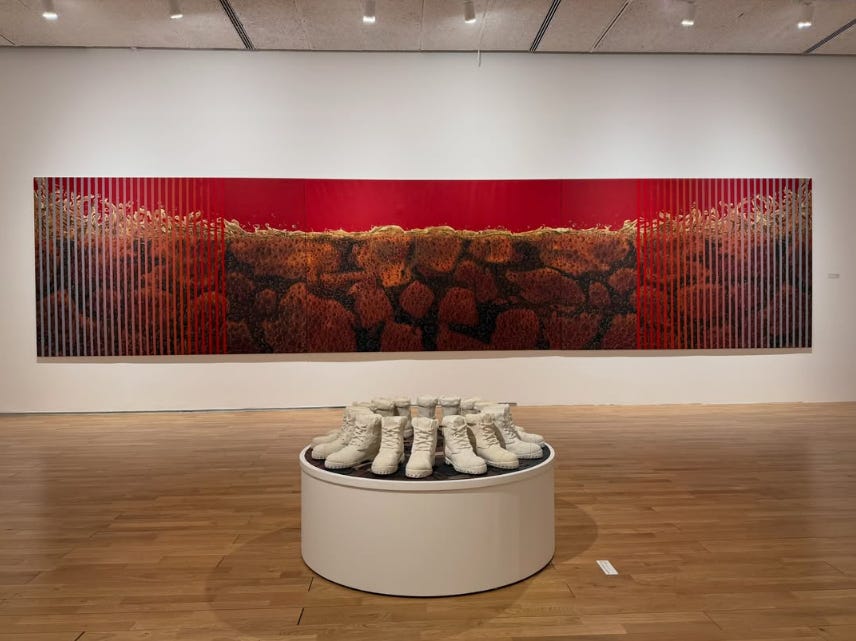
The artworks in The Field of Dreams, particularly those in the Living the Dream series, assume a provocative form and reflect transformations in Bashar Khalaf’s artistic practice in three respects. First, they strengthen the process of negotiation between people and things. Second, they enter worlds previously shaped by others, enabling an understanding of the new reality and an engagement with its complexities. Third, they intersect with contemporary art in other times and places.
This becomes clear when we look closely at Bashar Khalaf’s largest work, the ‘Coca-Cola’ painting, which expresses escalating consumption. In doing so, he democratises art by using a product known to everyone and engages with Pop Art in order to give his work a populist character, just as Andy Warhol did when he produced his famous Brillo Boxes.
Everything presented in The Field of Dreams consists of things we see every day and pass without question. What makes these things art when a similar object outside the exhibition is not art? What makes them art if, ultimately, they are either scrap or an advertisement for a drink? What distinguishes the artwork from the non-artwork when the two appear, in fact, entirely alike? Is it the dark regions concealed behind things, where ghosts and fears reside, or are these things manifestations of our weakness and signs of our fatal divisions? They lose their ordinary existence and come to loom over the canvas like fleeing ghosts, demanding our attention.
The Field of Dreams poses profound questions about whether humanity will adopt choices fundamentally different from the contemporary process of domination and its colonial, capitalist and even cultural transformations. Perhaps Bashar Khalaf restores the power of critique through his artistic project by capturing the ray of darkness taking shape within existing ideas and the questions they contain.
References
Agamben, Giorgio. (2009). ‘What Is the Contemporary?’ In What Is an Apparatus? and Other Essays, translated by
David Kishik and Stefan Pedatella, pp. 39-54. Stanford, CA: Stanford University Press.
Braudel, Fernand. (2008). Dinamikiyyat al-Ra’smaliyya [The Dynamics of Capitalism], translated into Arabic by Shafiq
Muhsin. Beirut: Dar al-Kitab al-Jadid al-Muttahida.

About the Author
Jad Izzat Al-Ghazawi is a poet, academic and researcher in visual arts, born in the city of Tulkarm. He comes from a refugee family whose roots extend to the village of Qaqoun, occupied in 1948. He holds a master’s degree in Contemporary Art from Dar al-Kalima University. Al-Ghazawi has published three books, whose titles translate as
Loser, O Noble One; What Is Missing from Me; and Seasons of the Dolls.