


The concept of time banking largely originated with US civil rights lawyer and political activist Edgar Cahn in the 1980s to directly address social inequity and communal isolation. In the past decade, the number of individuals participating in time banking in the US has nearly doubled. This growth could be due to a variety of factors: the increased use of time-banking apps, the isolation of the COVID-19 quarantines, and the growing value placed on the invisible economy of simple acts of caretaking alongside companionship.
The fundamental rule of time banking is that one hour of providing a service equals one time credit or time dollar. Unlike traditional economic systems or bartering, time banks do not value one type of service over another—teaching someone Spanish is as valuable as fixing someone’s brakes—and you can bank as many hours as you’d like. But what keeps people engaged in communities that provide goods and services without any monetary exchange?
Power of Connection
“When I joined the community, and I joined the time bank, I didn’t know many people. It helped me connect with the community and meet other people because I felt lonely…What can I offer the community? My sign language, that’s what I like and love to do because of my daughter.” – Susana Santillan
Susana Santillan has been a member of the Mesilla Valley Time Bank since 2020, beginning her experience as an American Sign Language (ASL) teacher, a practice she’s continued to this day. Santillan noted the time bank allowed her to interact with people she’d otherwise never meet, something she was especially grateful for when she joined in the height of COVID-19 quarantines. Santillan, a very giving person, was immediately drawn to the time bank to strengthen connections with her community.
“I don’t count that time as money or anything like that… to me, all I concentrate on is that I give, and if I receive, that’s a big help… If I can help, I help. That’s part of me. I enjoy helping… I’m able to meet a lot of people that I wouldn’t have ever met if I hadn’t joined the time bank. I started meeting all these people, and it’s wonderful, and they have different skills. There are authors that have a book club, [and there’s] arts and crafts. I’m not very good at arts and crafts.”
Although Santillan began her time bank experience through giving, she has also received much in return. The service she offers naturally helps her and her daughter navigate the community, since her daughter is legally deaf. Santillan has received many time credits from those interested in her classes, and in return, she has used them for a variety of services and experiences, including fence repair, car service, yard work, and even joining a Dungeons & Dragons campaign.
“I like to do it because I like to be with people… Sometimes we say we’re volunteering, but we don’t realize how much we get back until you think about it. And some people are like, ‘I’ll go to the meeting once or twice and see how it is,’ but it’s hard at first, because, you know, there are people that think, ‘why would I do [this for] free?’ It’s because you realize people do stuff for free because they want to be around people, or just to help. The sense of helping people is a big reward.”
Time banks are highly effective at fostering a tight-knit community that values individual skills not for their monetary value but for their emotional value. Each experience Santillan shared revealed a new way in which people who would have been strangers could share a moment of camaraderie. Time banks strengthen community and deemphasize personal wealth by placing everyone on the same level; it doesn’t matter if you’re able-bodied or disabled, unhoused or housed, employed or unemployed. They focus on what someone can do rather than what they cannot.
Changing Perspectives
Patricia Mendoza currently serves as the Director of Doña Ana Communities United and the Mesilla Valley Time Bank Coordinator. Mendoza began her journey as a shy stay-at-home mom desperate to break outside of her tiny bubble and become involved in the larger local community. The time bank provided the perfect outlet for creating community, inspiring Mendoza so much that she quickly took on an executive role.
“It brought up the confidence in me to be able to talk and motivate others as a sort of ‘if I could do it, you can do it ‘ kind of thing. And honestly, it sounds cheesy, but I do believe everybody has something to offer… a degree is important, but just because you can’t afford one or didn’t have the time to get one doesn’t mean that you don’t have skills or something to give to the community.”
Mendoza further emphasizes how the time bank values all skills regardless of how much they would “cost” in any other economic system. Capitalism is so deeply ingrained in the way most Americans view the world around them that every act, no matter how charitable, is viewed with a dollar amount beside it: “time is money.” Given this mindset, one would not be able to exchange kitchen help for an astrological reading, but this is a situation Mendoza was happy to find herself in.
“One of the first ones that I exchanged was with a time bank member who is immunocompromised, so she cannot go to group gatherings and such, and she does astrological chart readings and tarot card readings and things like that. So I thought that was very unique and nice, that [the time bank] took that in as a skill. Because in other places they would be like, ‘that’s not a skill to be marketable,’”
As a first-generation graduate who placed much time and effort into attaining a degree and getting a job, Mendoza found herself holding biases toward the impoverished, unhoused individuals in her community. The time bank provided an outlet for these community members to engage with people of different economic statuses in a nonjudgmental exchange of skills. Mendoza’s exposure taught her to treat unhoused members as equals, and she kept in touch with some after they left the program.
“I was very biased against unhoused individuals. I was scared of them. And so the previous director taught me that they’re humans, and you need to treat them equally. They’re not gonna hurt you, like I know it sounds foolish now that I said it out loud, but… being part of the time bank opened my eyes to other parts of the community, and [it increased] my empathy for others and sympathy… There are a few time bank members who are not active anymore, because obviously they are going through their issues, but if I see them around town, I’ll give them a blanket or, you know, if they need extra cash… So I think that was a lasting impression for me when it comes to personal growth.”
Mendoza has obtained a great number of friendships through her experience in the time bank. “Grumpy” Ben, a notable time bank volunteer, first intimidated her with his loud excitement, a stark contrast to her usual quiet introversion. But over time, the duo became integral to time bank brainstorming. Kelsey is another member Mendoza mentioned because of her particularly interesting time bank service: group Pokémon Go hunting. Mendoza’s relationships provide a powerful example of what kinds of connections can grow after the initial awkwardness or nervousness of a time bank exchange.
“The biggest challenge is trusting people because they’re strangers, and the first reaction is, ‘I don’t want a stranger in my home,’ which I wouldn’t want a stranger in my home either… Our time bank’s goal is to reduce social isolation, so we focus a lot on connections and group gatherings. I would suggest, if there are monthly socials, monthly potlucks, a group exchange, go to those, even if it’s one or two, so you can meet those time bank members, and you get to meet others. Google them, search them online, on social media, make yourself feel safer around them, and meet them in a public space.”
As a leader within her time bank, Mendoza has had to learn to let go of her micromanaging tendencies and place great faith in the volunteers and team members. This collaboration has given Mendoza the opportunity to lean away from hyper-independence and allow herself to seek help from the people around her. It truly does take a village to uplift a single person in a community, and the time bank has provided the perfect outlet to create that village.
“It is harder to receive than to give, because we all have this mentality that I am strong and independent and I don’t need help from anybody... but we always need help from somebody at some point, and any small skill or help that we can get will make a difference and make the other person feel important and valuable in society.”
Learning to Give
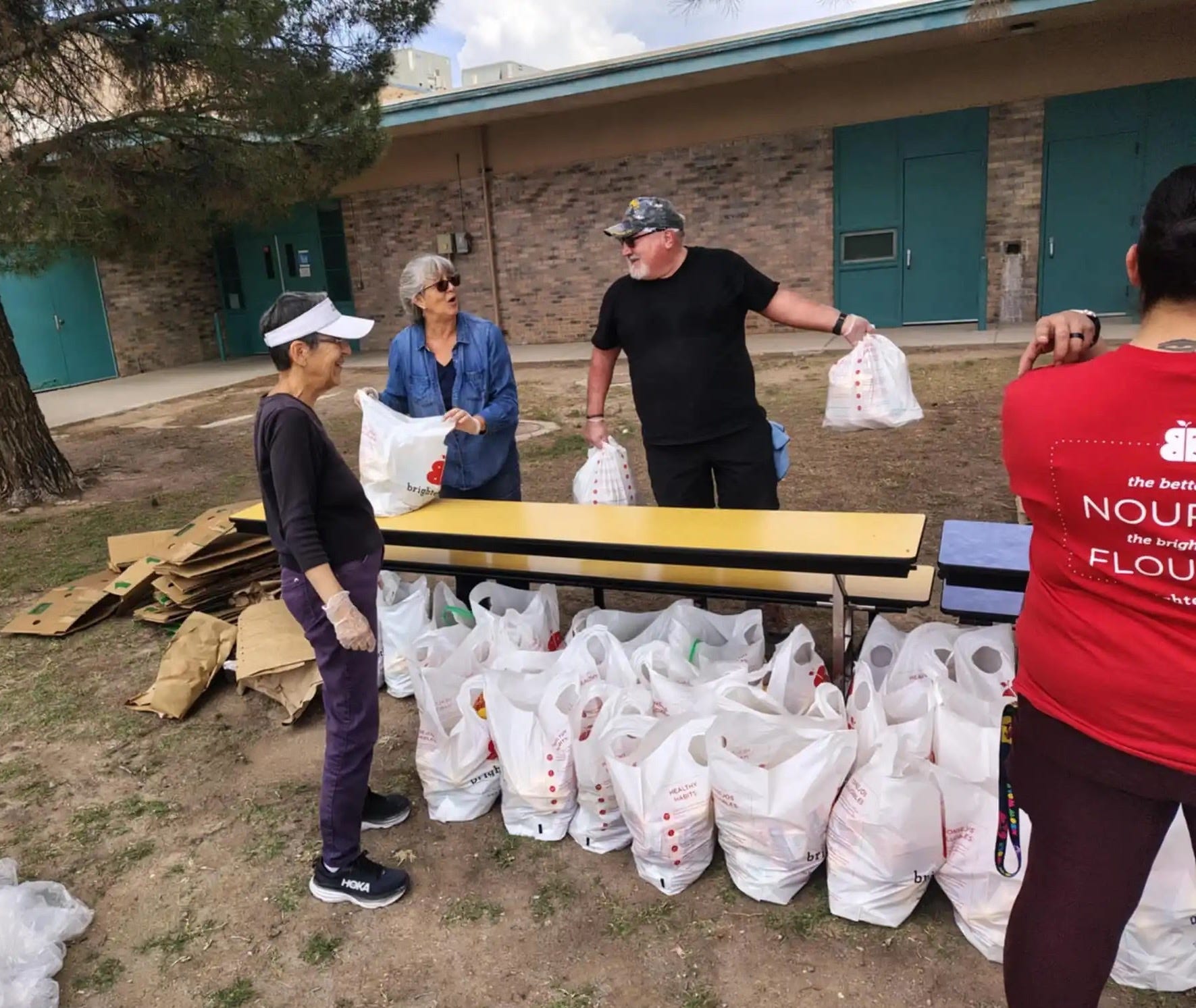
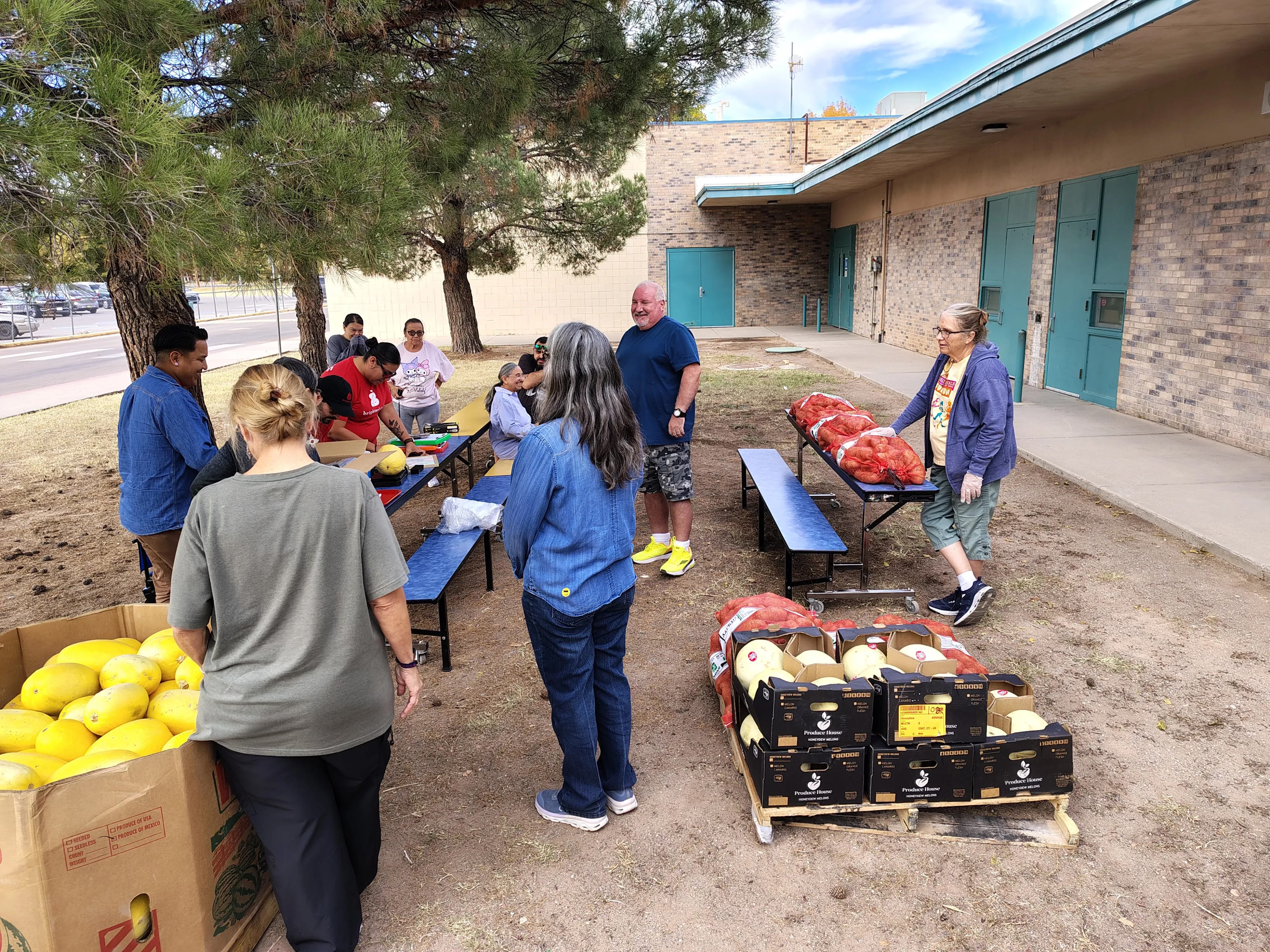
McKenzie Yazzie-Martin found the time bank through his position as a program manager for the nonprofit organization “Brighter Bites.” Yazzie-Martin needed volunteers to help distribute fresh food to local families and schools, the time bank was the perfect place to find them.
“Sometimes I get more people who are willing and wanting to help… So I’ve had some people kind of just, not standing around, but wondering how they could help ‘Brighter Bites.’ Yeah, and in this case, I have people who I give a bag [of fruits and vegetables] as well as appreciation. I mean, overall, the challenge that I’ve had is managing a bigger team than I anticipated.”
As a volunteer coordinator, Yazzie-Martin found the time bank system particularly unique because it allowed him to reward volunteers with service hours they could use to receive services for themselves. Exchange of services creates a beneficial cycle rather than people feeling as if they are “wasting time” by volunteering because it has no monetary value. The time bank also provides “Brighter Bites” with a wide variety of skill sets, ranging from highly involved leadership to simply spreading the word about the organization.
“I see the skills of other people in terms of what they bring to ‘Brighter Bites.’ A lot of them have leadership skills or organization skills. A lot of them communicate, kind of elaborating on what the program is, and then sharing that knowledge with parents who are within the public or within the community schools… we’re helping the community create a more diverse nutrition aspect… [the time bank] also helps me bring up my skills as well with the leadership part and the management part.”
Overall, Yazzie-Martin has found the volunteers from the time bank to be extremely communicative, helpful, and loyal to the people they help. The interactions within this program have become less like transactions and more like a family. Members are deeply invested in spending time together and supporting one another.
“Everybody is super communicative, very loyal to the people that they help. It’s their own community, where it’s kind of more like a friendship, and the majority of the people think of it as like a family initiative, to the point where they spend a lot of time with each other.”
Although Yazzie-Martin hasn’t yet ingrained himself in the Mesilla Valley Timebank by providing his own services, the community has already inspired him to view his hobbies through a different lens. He has offered photography and yard work services to much appreciation, but he has struggled with asking for services outside of “Brighter Bites.” Sometimes, giving freely is a lot easier than receiving freely, but both are essential to the reciprocal nature of the time bank.
Redefining Wealth
The current political climate, especially in the US, is extremely divisive, frightening, and lonely. The most important thing to foster in this moment is community. Increased online connections have led many people to avoid in-person interactions, even when those interactions can arise from small, seemingly insignificant acts. Not every interaction within one’s local community needs to be a structured “hangout”; even being in the same space as someone, chopping some vegetables, can create a meaningful connection.
One does not need to be an expert on, well, anything to be part of a time bank. Think of the things you enjoy doing for yourself or others: playing board games, baking pastries, reading books, patching clothes, or planting flowers. All of these acts are given the same “currency” as an hour of someone else’s time. Just an hour of your time could be the first step in weaving together your local community. There is no bar of entry for a time bank.
There might be a time bank near you! Websites like “hOurworld.org” and “TimeBanks.org” could help you find one in your area. If you are unable to find one in your area, consider starting a chapter yourself! It only takes one person to make a real difference.
