


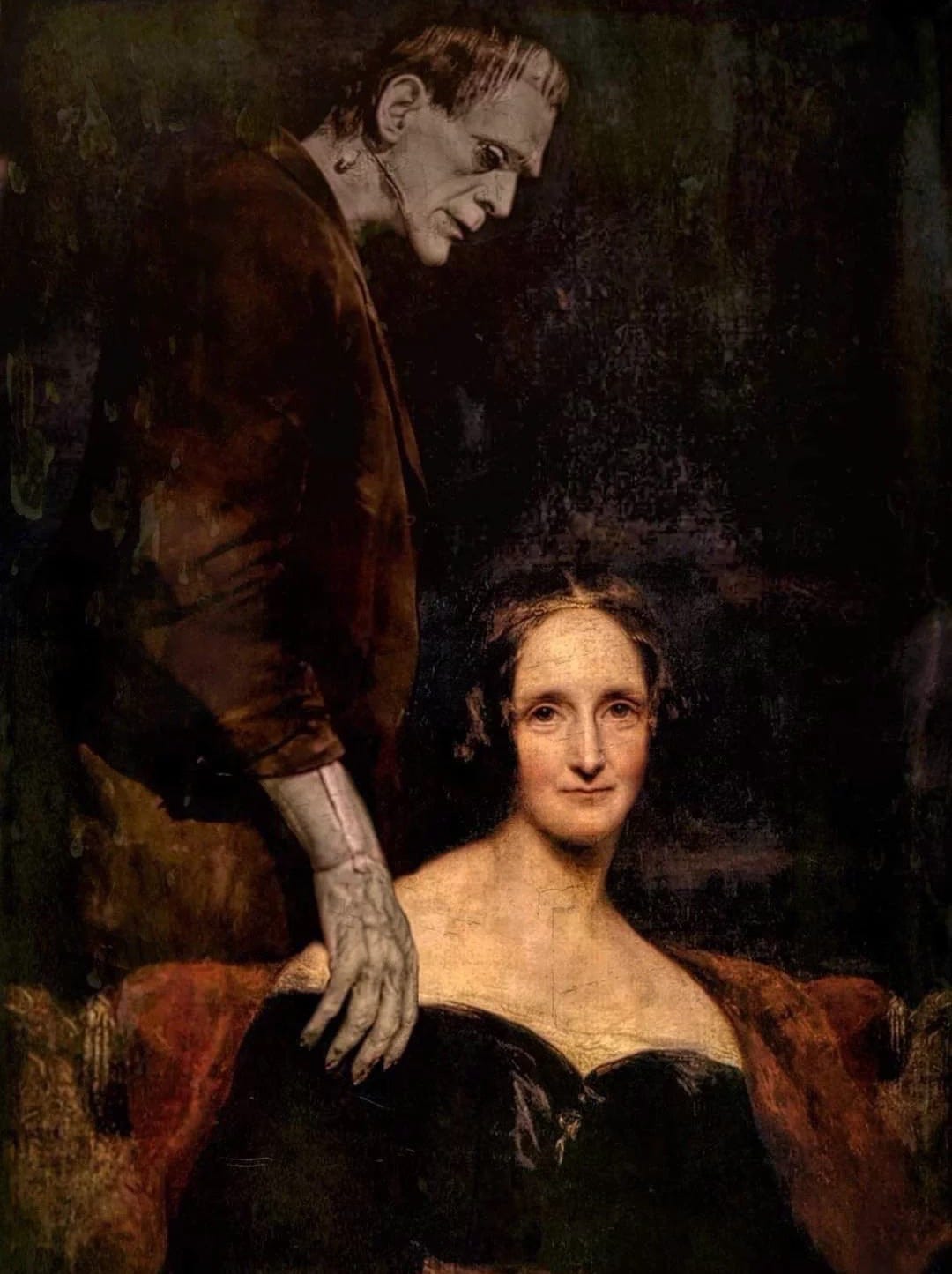
Mary Shelley is the mother of Gothic literature ever since she wrote and released her novel, Frankenstein. Many people have taken an analytical approach towards this novel and Mary Shelley herself in comparison. In Kathleen Béres Rogers’s article “The Monstrous Idea in Mary Shelley’s Frankenstein”, she says that “scholars have contributed valuable psychoanalytical readings of Victor Frankenstein’s various obsessions-be it the homosocial obsession with the creature, his filial obsession with his mother, or even his obsession with his father’s lack of love” (p356). On a further look into Frankenstein, one can see the similarities between Mary Shelley’s mental state and life and that of her main characters, Victor Frankenstein and the “monster. ” By focusing on Mary Shelley’s background and relationships she had with her family, friends, and the influences they had in her novel without contributing, it can be compared to Victor Frankenstein’s own relationship with his family and the “monster” he creates.
Mary Shelley grew up with her father, step-mother, and step-sister. Her mother, Mary Wollstonecraft, died shortly after she had given birth to Shelley, and it had been a guilt Shelley lived with her entire life. She had wished for her mother and visited her mother’s grave regularly, even into adulthood when she met with Percy Bysshe Shelley before they married. In “Mary Shelley as Frankenstein” by Elisabeth A. Waites, she describes in her introduction, “After a whirlwind of courtship of secret meetings with Shelley at the grave of her mother…” (pg. 583). Going into her relationship with her father, Mary Shelley and William Godwin had a strained relationship as she was growing up, as her mother was the reason he opened up into life and when she died, he became even more closed off than he was before. This grew worse when he married Shelley’s stepmother due to the strained relationship with the stepmother as well. And this worsened when she “slipped furtively from her father’s house in London to join Percy Bysshe Shelley who was waiting to elope with her to the continent” (Waites, pg 583). Waites then continues to describe the state of either side’s family during this, “[Percy Shelley] had recently left his pregnant wife and child, and had been angrily cut off by his father. Mary’s father, William Godwin, was also furious at the runaway couple and refused to be reconciled” (Waites, p583).
Mary Shelley is seen using her relationships as influence within her novel. Starting from how she thought of the novel to why she wrote it, and the comparisons between herself and the characters. Shelley felt a lot of guilt by feeling like she was the cause of death for her mother and felt even more guilt when she lost her first child after two weeks of giving birth. Waites explains that “Mary grieved her loss but was soon pregnant again…she gave birth to a son” (Waites, p583). The fact that she struggled so much with motherhood and birth can be related into the fact that in her introduction of the novel, Frankenstein, she calls the novel her “hideous progeny.” Her description can be seen as a reference to how much she struggled with motherhood with the loss of her own child and then creates Frankenstein during another pregnancy, where she could potentially have the same problems as her first child. Shelley’s struggles are analyzed by Stephen Bann who “interprets association by drawing a double analogy with Mary Shelley’s own ‘anxiety of authorship’ and ‘anxiety of monstrosity.’” (Onega, p126). In the book, this can be shown with her character Victor Frankenstein as well. Victor Frankenstein had a close relationship with his mother in the novel before she died. She then sets this guilt upon Elizabeth because “Elizabeth had caught scarlet fever…[the mother] attended her sick bed…Elizabeth was saved, but at the consequences of this imprudence were fatal to her preserver” (Shelley, p 65). Shelley is seen to have put a lot of herself into the novel’s characters.
Victor can be seen to the Creature the same way Dr. Jekyll can be seen the Mr. Hyde. Throughout the novel, both characters mirror each other in different ways. When being introduced to Victor, we are told that he wants knowledge. He consumes chem and alchemy even when his father and one of his professors tells him it is useless. He goes so far to create the perfect man, so that he can prove that he could create life. The creature on the other hand also wanted knowledge. He wanted to know how to speak the language, he wanted to know how to build a life, how to speak to people, and how to interact with everyone. He yearned for any kind of relationship with Victor and other people. But just like how Victor shunned his own creation, the creation was shunned by the world, and then shunned the world back. Shelley perfectly captures Victor’s feelings towards the creature, “instantly informed me that it was the wretch, the filthy daemon, to whom I had given life” (p 96). Continuing onto how the creature murdered those who had done him wrong. “Could he be (I shudder at the conception) the murderer of my brother...I became convinced of its truth…” (p 97). Victor’s brother, Victor’s friend, and Victor’s wife. After being completely betrayed and shunned by his creator he exacted vengeance on him and in return, Victor ended up dying because he wanted his own vengeance on the creature.
Victor’s own lust for knowledge can be taken back all the way to Mary Shelley herself. In the “Motherless Child in Science Fiction” by Steven Leeman, he states that “Mary Shelley’s grief over the death of her baby is refracted through the obsession of her “mad scientist protagonist”, Victor Frankenstein…underlying his megalomaniac hunger for power through procreative science” (p 49). Indicating Victor’s own want is reflected from the fact that Mary Shelley wanted her baby. The death of the baby turned Mary Shelley into a grief stricken woman which she put into Victor with his obsessions. His obsession with learning and with the creature. The creature also has an obsession, he was obsessed with the suffering of Victor.
Works Cited
Capri, Daniela, editor. “Monsters and monstrosity.” De Gruyter, vol. 16, 17 June 2019. Law & Literature, https://doi.org/10.1515/9783110654615.
Lehman, Steven. “The Motherless Child in Science Fiction: ‘Frankenstein’ and ‘Moreau’ (L’Orphelin de Mère Dans La Science Fiction: ‘Frankenstein’ et ‘Moreau’).” Science Fiction Studies, vol. 19, no. 1, 1992, pp. 49–58. JSTOR.
Onega, Susana. “Patriarchal law and the ethics and aesthetics of monstrosity in Mary Shelley’s Frankenstein.” Edited by Capri. Monsters and Monstrosity, vol. 16, 17 June 2019, pp. 115–130. Law & Literature, https://doi.org/10.1515/9783110654615-007.
Rogers, Kathleen Béres “The Monstrous Idea in Mary Shelley’s Frankenstein.” Literature and Medicine, vol. 36, no. 2, 2018, pp. 356-371. ProQuest, doi: https://doi.org/10.1353/lm.2018.0018
Soccio, Anna Enrichetta. “Victorian Frankenstein: From fiction to science.” Edited by Carpri. Monsters and Monstrosity, vol. 16, 17 June 2019, pp. 131–140. Law & Literature, https://doi.org/10.1515/9783110654615-008.
Waites, Elizabeth A. “MARY SHELLEY AS FRANKENSTEIN.” Psychoanalytic Review, vol. 78, no. 4, 1991, pp. 583. ProQuest, https://www.proquest.com/scholarly-journals/mary-shelley-as-frankenstein/docview/1310158072/se-2
Edited by Hannah Villegas
