


The “maiden, mother, and crone” archetype is used to reduce women to three stages of life. However, through the lens of Wicca, this demeaning phrase is altered into a divine trinity representing feminine power. The maiden, mother, and crone align with phases of the moon’s cycle, connecting the life cycle of women to the cycle of the universe. In this sense, “Howl’s Moving Castle” stars a very witchy female lead, the grumpy, self-assured, and benevolent Sophie Hatter.
Sophie as Maiden
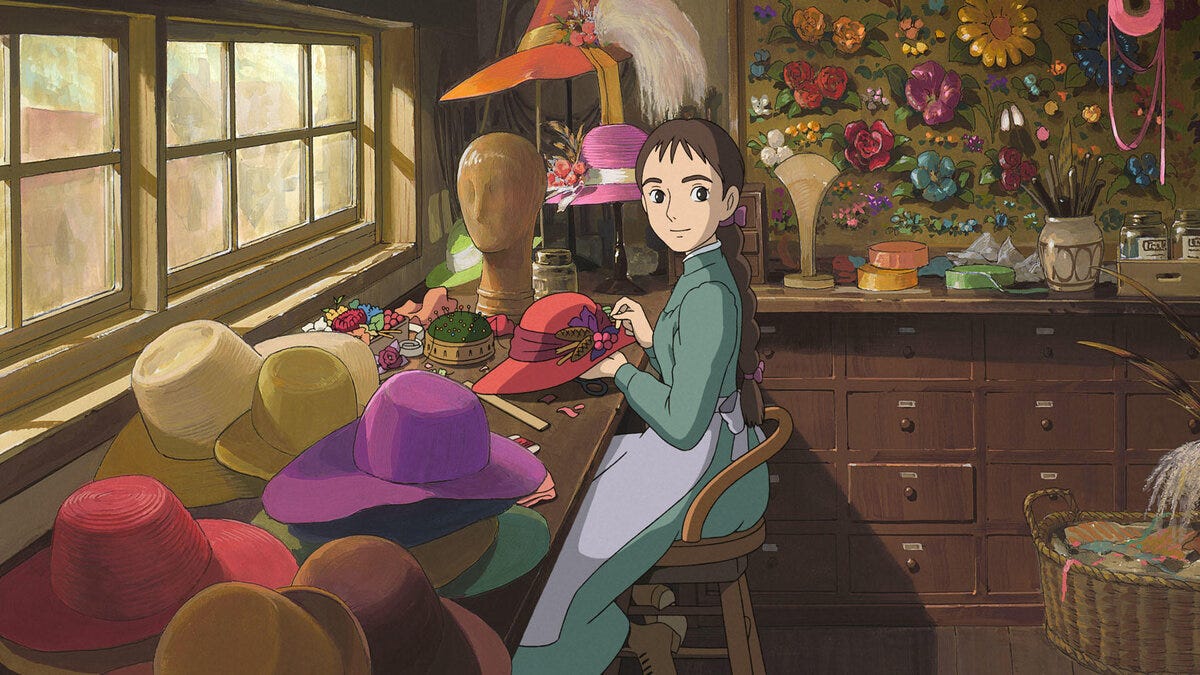
The “maiden” archetype is defined as a woman who is pretty, docile, and youthful. This is how Sophie begins her story, staring out the window of her family’s humble hat shop as her sisters leave to dawdle around town. She lacks agency, acting with passivity even when Howl lifts her into the air to save her from the Witch of the Waste’s henchmen.
Some have argued that Sophie plays into the “Cinderella” stereotype, as she begins the story as a girl helpless to stand up to her surroundings and is rescued from her “tragic and dull existence” by a man. In this way, Sophie is a sort of damsel in distress, but she is much stronger-willed than a Disney princess. Notably, her love brings the story to a peaceful conclusion, reducing her witch-like power to love, a trait many fairy tales portray as primarily feminine.
“Howl is Sophie’s saviour. Sophie’s love for him sprang from that initial act of manly valour. And furthermore, we get the impression that she did in fact need saving, or else she’d still be stuck at the hat shop, sighing about not feeling as pretty as her siblings,” @FaerieStories said in a Reddit post on “Howl’s Moving Castle”’s gender politics.
However, Sophie has many instances of independence, self-confidence, and boldness. As the film progresses, she is proven to be a woman who can hold her own, even reprimanding Howl for his cowardice. It is inarguable that Sophie’s unique personality and growing confidence further both the plot and her own self-maturation. She is not confident solely to help Howl and the other inhabitants of the moving castle; she is confident because she believes in herself and her capabilities. Howl doesn’t do much to increase this self-assuredness; it is almost solely an internal journey for Sophie, something that strays from the typical “maiden” archetype.
Sophie as Crone

The original use of the term “crone” is derogatory, not only calling a woman old but also withered, ugly, and cruel in contrast to the usual definitions of female power: youth and beauty. Sophie becomes a “crone” after the Witch of the Waste casts a spell on her; her wrinkles are exaggerated, her voice is hoarse, and her attitude is curt. However, this curse turned into a blessing, serving as the catalyst for Sophie’s maturation throughout the film.
Throughout her essay, “Confronting Coming of Age and War in Hayao Miyazaki’s ‘Howl’s Moving Castle’,” Xinnia Ejaz explains how Sophie’s character subverts common Japanese “shojo” tropes: she is not idealized, not sexualized, and looks like an old woman for most of the film. What would usually be a major setback for any shojo protagonist becomes a springboard for Sophie, as she grows more confident as an old, wise woman who doesn’t feel belittled by the male gaze (as seen in the scene with her and the two flirtatious guards).
“Even though youth is admirable in women, at the same time, youth, when seen through a male gaze, reduces women to an object of desire. Society reduces a woman to a mere body while old age finally opens up the world to her gaze” (Ejaz, p. 15).
Although Sophie is initially shocked and horrified by her short, weak, wrinkled stature, she immediately adapts, cheekily remarking that her clothes suit her better now. This archetype provides Sophie with the wisdom to become a mother figure to the inhabitants of the magical moving castle, including the very immature Howl.
Sophie as Mother
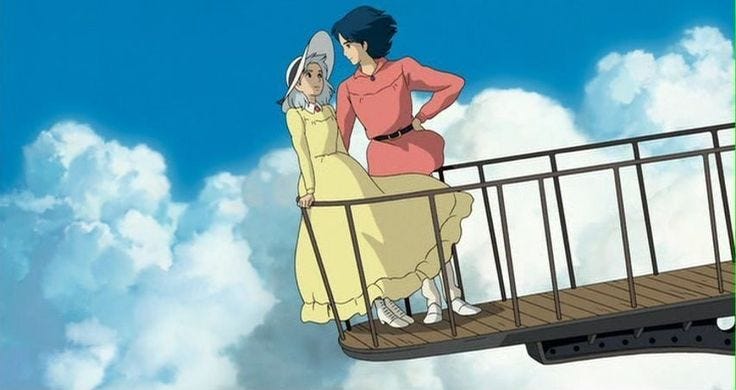
Sophie’s motherly nature is integral to her character and the story as a whole. Many say maternal instincts vary with age, but it’s actually been proven that the popular idea of how maternal instincts develop is largely untrue. Not all women inherently gain a sense of maternity over those younger than her as she grows older; this is a misconception driven by what society expects a woman to act like, so if not her perceived maturity, what drives Sophie to become the “mother” of Howl’s moving castle?
David Rudd’s article “Building Castles in the Air: (De)Construction in ‘Howl’s Moving Castle’,” examines the character of Sophie through the lens of Diana Wynne Jones’ novel, which the film was based on. Rudd argues that Sophie’s instantaneously becoming a broom-swinging, wisdom-carrying, and wise-cracking mother figure gives her power in this story rather than taking it away. In many stories, the “mother” character is only valuable for serving the more important characters who surround her. However, it could be argued that “Howl’s Moving Castle” is more a story about Sophie than it is about Howl.
“Sophie is subversive of fairy tale orthodoxy in one other key way, too, in that she moves towards the hearth rather than away from it. However, in doing so, she also moves into the driving seat of the story, … That is, she becomes the archetypal Mother Goose, spinner of tales: old and opinionated, yet influential” (Rudd, p. 262).
Sophie finds her power in the mundane practices of a mother. She brings about the end of the war just by being kind to a turnip-headed scarecrow and saves Howl by hugging a very rude little witch. She is the first person, besides Howl, to tame the evil fire demon, Calcifer, just by giving him a few stern words. Her motherly nature further distances Sophie from the stereotypical “shojo” trope, as she holds her own throughout the entirety of the film.
Sophie is emblematic of the divine trinity of feminine power; her story and actions are unashamedly feminine, without diminishing her agency. Her love is only one part of her power, and, paired alongside her confidence and self-growth, she makes Howl’s moving castle a home; Sophie wields a broom like a sword and gives love like it’s a potion, keeping her grey hair along the way.
