


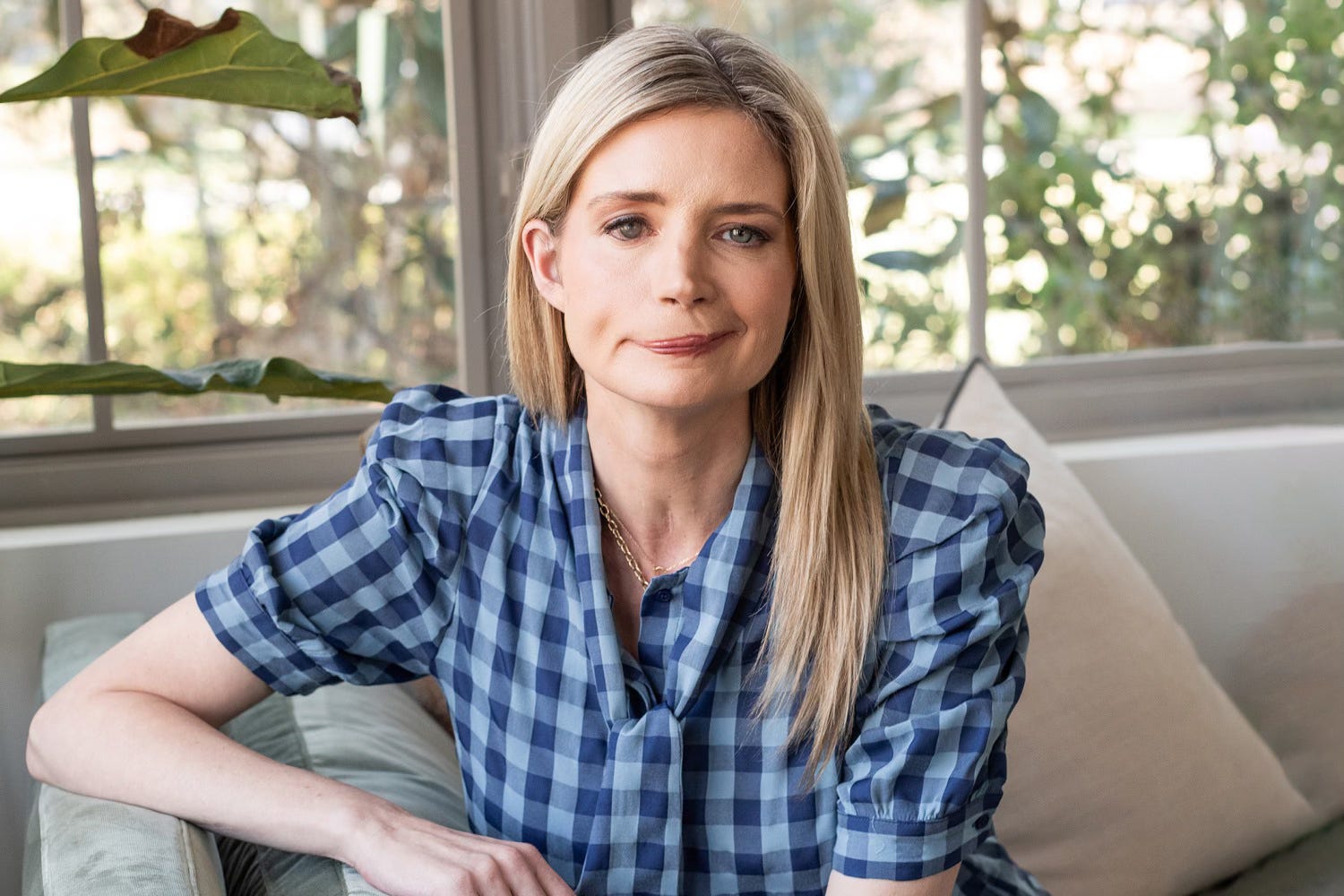
Recently, I attended a women’s church conference at Fellowship Community Church. The keynote speaker was author Katherine Wolf. In April of 2008, a 26-year-old Katherine, without warning, just 6 months after giving birth to her first son, collapsed in her kitchen and suffered a massive brain-stem stroke. She spent 40 days in the ICU on life support after going through the surgery which saved her life but took away nearly each one of her physical abilities. She then underwent two years of intensive therapies to relearn how to eat, walk, and talk.
Even though she survived despite all odds, Katherine refuses to call herself a miracle. Rather she acknowledges that life, after all she’s endured, is hard, frustrating, and exhausting. In 2013, her neurologist discovered and operated on an aneurysm within her brain, and she developed multiple lethal vertebral artery dissections in 2017. In 2019, she was confirmed to have an incredibly rare and undiagnosable neurovascular disorder called Moyamoya Disease, in addition to Intracranial Stenosis.
Her book, ‘Treasures in the Dark’, was the book that Anchored in Hope, a bible study I attend at Fellowship Community Church for women with chronic illness, just finished a series on. At the conference, Katherine touched upon many of the lessons she covered in her book.
What she talked about that resonated with me the most was the verse Galatians 6:4-5, the Message Version, which reads, “Make a careful exploration of who you are and the work you have been given, and then sink yourself into that. Don’t be impressed with yourself. Don’t compare yourself with others. Each of you must take responsibility for doing the creative best you can with your own life.” Each line of this verse gives an instruction, a guide to live our lives by. Paul isn’t just telling us to look in the mirror, at what we see, and study our reflection. Paul is telling us to look at each and every piece of ourselves, the good and the bad, all the bits that make up who we are, even those that are the most broken parts.
If we look closely, we’ll realize that the work we’ve been given often correlates with who we are inside, with each of those bits and pieces that make us who we are. We are called to dig into that, because that work is how we will impact others who are hurting or in similar situations. If we pour our hearts and souls into first discovering who God made us to be, and why, we are better equipped to lead others, to allow them to find their true calling, their purpose scattered amongst the pieces of their own lives.
We are called to look at not only what we see in ourselves, but to—as Katherine put it—“cultivate ridiculous gratitude for what remains. For those of us with chronic illness, this verse isn’t just a list of instructions; it’s our way of life. We learn to redefine what a happy life looks like, and by doing that, we beat the devil at his own game. Because he wants us to think that because our life doesn’t look like everyone else’s, we could never be joyful, or praise God. So, when we, as Paul instructs us to, “do our creative best with our own lives”. We’re redefining what joy is, what hope is, what goodness is, by thriving, despite everything that tells us we can’t live a good life. Don’t let the devil win; get creative and inventive with your own life. Because when we are creative and make the most of what we have. Everything is not picture-perfect, but we’re showing the world that we can trust God in the creatively messy life we’re living, because he is the master artist and the author of it all.
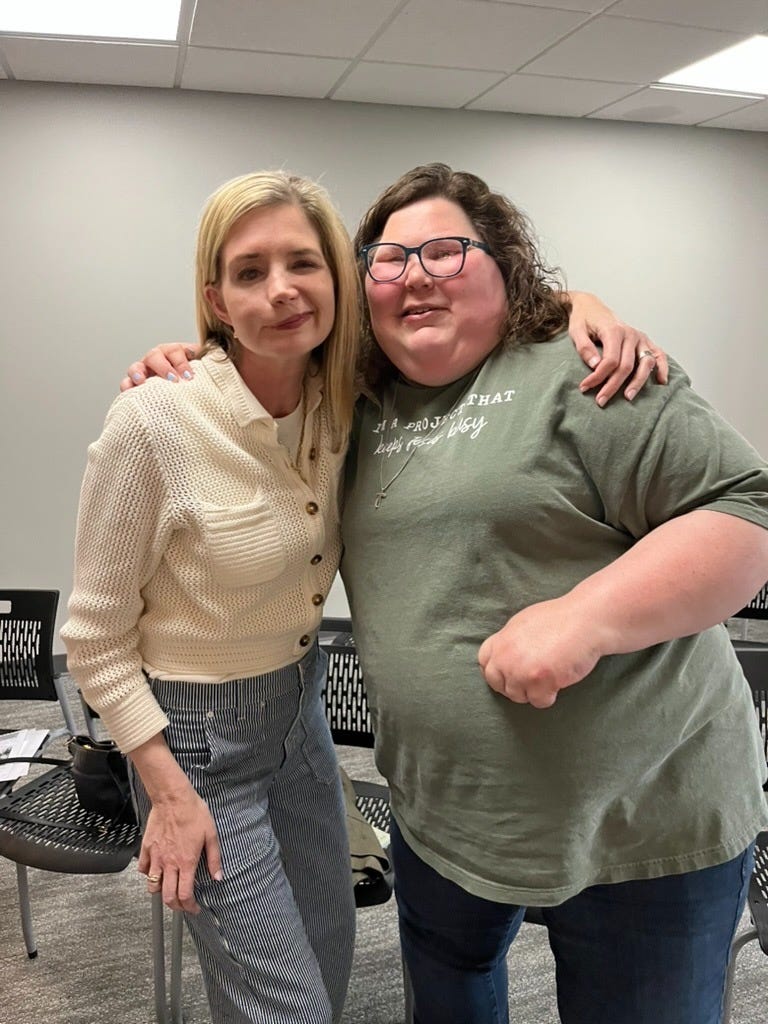
The next lesson Katherine shared was the beauty of sharing our darkest places with others. She explained how we are living as a survival guide for others. Whether we know it or not, others are watching us navigate our own journeys. We may never fully grasp the impact that our story can have on someone else. Others may use our same battle tactics, or use our words as a map to help them out of the woods.
“While my suffering has no quota, neither does my hope.” This is one of my favorite quotes from Katherine’s book, which she discussed during the conference. She talked about how none of us is guaranteed that our days ahead of us will not be harder than our past. If we focus on only the hard things, that’s all we’ll see. She then mentioned that if we choose to flip this around, we can see that if something good has happened to us once, good things can happen again. She explained that if we’re willing to open our eyes to see the good things, our future can be full of them. While there may be an abundance of hard days ahead, there may be an abundance of good days ahead as well.
One thing that Katherine stated during her speech was that if we are here on Earth, we are supposed to be here. This really stuck with me. If we’re still here on Earth, we’re here for a reason. Our story isn’t finished being told yet. For those of us with chronic illness, we often struggle with the guilt of needing help from the people around us. We often feel like a burden to our family and friends. But we don’t have to feel bad about needing help from others. We’re a part of their lives, a part of their stories for a reason. If we’re on this Earth, we’re here for a purpose. God is still using us for something bigger than we could ever imagine. Just as Katherine said, “I might need help getting to the table, but I still have a seat there.” The same is true for all of us; we are still here, still alive, for a purpose, for a reason.
Another important note that this amazing woman remarked was that every one of us has a different brand of brokenness. We might not always see other people’s brokenness the way we see our own. They might do a better job at hiding it, or it might not be something so physically evident. But every single person has something that has broken their heart, leaving them frantically trying to glue the pieces of it back together before anyone notices. Whether it be loss and grief, addiction, disease, insecurity, etc., each of us is going through this world in physical or invisible wheelchairs. Every one of us is fighting to hold ourselves together inside, in fear of appearing broken to the world. Our brokenness, funnily enough, as empty as it can make us feel inside, is the one thing that connects all human beings together.
Katherine talked about redefining goodness, a concept that didn’t make sense at first when I heard it, but later realized it’s so essential to being able to pull ourselves out of this pit of suffering. You see, we can choose to see what was taken from us, in the midst of our pain and heartache, or we can choose to see the good that has come out of it, and will continue to pour out of our pain, if we just open our eyes and our minds enough to see it. Our idea of goodness might not look like what the world deems as good, but that’s okay. Our pain and our suffering have transformed our minds to be able to see the goodness in life despite the hard things we endure daily.
Another thing that Katherine communicated was that our trauma should be seen not as a diminishing of ourselves, but rather as an expansion of ourselves. We often look at our trauma and see how much we’ve lost because of it, how much of who we were before our pain has faded into the background. We tend to focus not on what we’ve gained, but what we’ve lost.
When it comes to trauma, it can often feel like we’ve lost part of ourselves, part of our identity is gone now. But at the same time, we’ve grown so much. One of the things I’ve often heard from my friends who have had brain tumors is that they wish their friends and family could see that they’re still the same person. I’ve often felt the same way. But Katherine opened my eyes to the fact that maybe, after our traumatic experiences, we’re not the same person. Trauma tends to give you a new perspective on what really matters in life, that the things we should be striving for aren’t the things the world tells us to go for. We grow from what we learn through our traumatic experiences, which is often more than we want to ever learn. So maybe, our trauma is not a diminishing of who we were, but rather, an expansion of who we were created to be.
One of the themes of her book, ‘Treasures in the Dark’, is this idea of a “good/hard” life. This is the idea that once again, while we will have many, many hard times in life, we will also have many good times in life. Katherine shared that “the good/hard life isn’t about ease, but about showing up scared to the ongoing hard in our lives, and choosing ongoing hope.” This is the idea that we don’t always know or see how the hard in our lives will turn out for our good, but choosing to hold onto the hope that despite all of the hard we face, something good is just around the corner. Also, choosing to fight through the hard to get to the good, no matter how long it might take, how uncertain our future seems, or how terrified we are.
The biggest takeaway I had from Katherine’s book and speech was that God can use our deepest, most hurtful wounds, to bring healing to the world. Through sharing our own story of healing in the world, through sharing our suffering, we can allow others to grab onto that tiniest thread of hope, that if we can pull through our darkest times, maybe, just maybe, they can too. One of the things that I loved about ‘Treasures in the Dark’ was that at the end of each chapter, she gives an affirmation, and then states, “If it’s true for me, could it be true for you too?” This is such a powerful statement, as simple as it may seem. Because what if we start not just encouraging others, but affirming that their pain will one day get better. By affirming that others wounds will someday be healed, that they will come out on the other side, is indeed how we change the world for the better.
Edited by Sonal Butley
Sources:
Wolf, K. (2024). Treasures in the Dark. Thomas Nelson.
