


The Contemporary Art era began shortly after World War II with the Abstract Expressionism of artists like Pollock and Rothko. As the center of high art shifted from Paris to New York, Pop Art, Minimalism, and Performance Art soon entered the public consciousness as reactions to a Cold War America, a confusing political era in which young men were being shipped off to fruitless proxy wars. Art movements have almost always been a reaction to the political, cultural, and technological surroundings of artists. In this way, the marvelous Impressionist paintings of Monet are no different from the experimental artworks and sculptures of Immersivism.
Immersivism is an art movement focused on the intersection of internet communities and “traditional” art, including painting, sculpture, and photography. It is a way to depict digital life through an artist’s eyes, not simply viewing internet social forums as something tied to a computer or VR headset, but as something that impacts life beyond the pixels through tangible, interactive art.
The term Immersivism was formalized in 2024 by the focus of this article, K Guillory, and her fellow artist, Bryn Oh. This art movement encompasses a broad range of styles and media, but it consistently centers on some aspect of cyberspace. Guillory describes Immersivism quite succinctly as “the art of the internet.”
Cyberspace as Subject
Historically, artists have only been able to depict the physical world or the imaginary using earthly imagery. Even when looking inward, painters like the cerebral Vincent Van Gogh could only depict his inner strife through the night sky, plants, or buildings. With the invention and popular usage of cyberspaces such as Second Life and VRChat, artists can create detailed renderings of people, places, creatures, and plants that do not or cannot exist in real life.
The popularisation of impressionist painting spread the practice “en plein air,” the seeds of which were planted by landscape painter John Constable, c. 1813, who pioneered outdoor sketching. En plein air’s direct translation is “in the open air,” and it entails painting an entire work outdoors in the presence of the subject(s) rather than in the studio, drawing on sketches or memory. The primary goal of this technique is to capture fleeting elements of the environment, such as how light bounces and the shades of the sky.
With the innovation of art capturing cyberspace, artists can bring this technique to settings you can only see on a computer or in a VR headset. This centuries-old technique relates to Guillory’s art, as she has depicted “outdoor” locations in virtual worlds. Traditional painting practices merge with the new age, as bounding cliffs can be painted on a solid, real-world canvas as she stands looking at the horizon of a VR space.
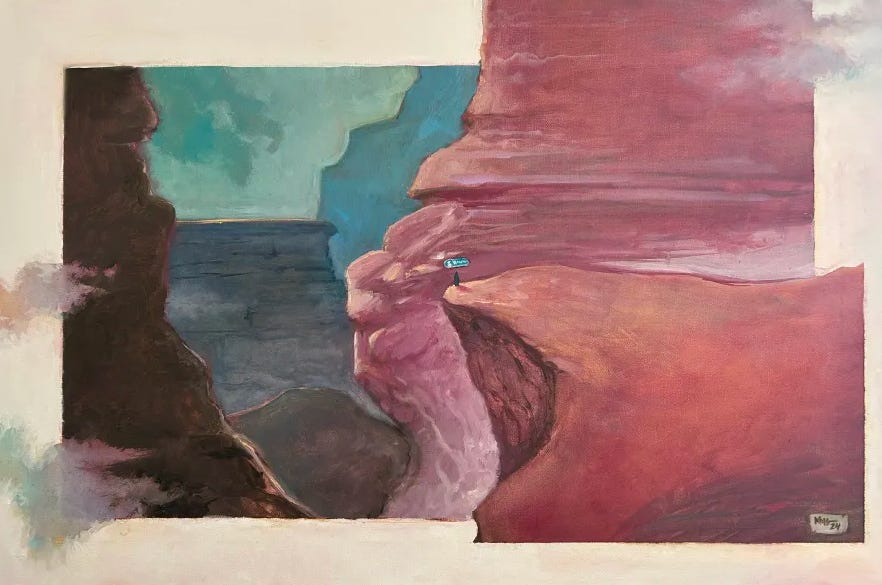
This is where Guillory’s signature practice of “blind contouring” assumes a pivotal role. When she wants to capture a physical “screenshot” of a VR space, Guillory is blinded from her canvas by the all-encompassing screen of the VR headset. To balance her physical process with the virtual setting, Guillory keeps a strict gaze on the avatar and/or environment she is capturing. Without visual feedback, Guillory homes in on the feel of her paintbrush across the canvas, channeling the texture of already laid pigment to guide her where she needs to go.
This technique is not entirely new; artists of the past have created techniques to capture a raw aura or vibe without being distracted by an intense focus on the canvas, materials, pigments, or traditional art rules. In the 1920s and 30s, at the height of the Surrealist art movement, artists such as André Masson and Joan Miró used “automatic drawing” to access their subconscious. They would work in near-complete darkness, allowing the brush to glide across the canvas almost subconsciously. Like Guillory, these artists tried to capture a hidden landscape, theirs being the mind and Guillory’s being the virtual.
Guillory’s blind contouring relies heavily on her intuition, consistently creating oil paintings that evoke a messy, tangled, bright, and human presence within a geometric, clean, and artificial digital space. She combines taking a quick screenshot with the practices of older art movements to create a human depiction of an inhuman space.
“I paint avatars, people, and places I find. As platforms die and become erased from the internet, my paintings record their presence and leave an artifact of who they were.” (K. Guillory)
Cyberspace as Medium
The concept of the artist’s studio is completely altered for Immersivists. Rather than being a small shack overlooking a stuffy city street filled with works in progress, messy canvases, and seating for prospective portrait sitters, an artist’s studio, while painting a virtual work, is always changing. This means your artistic space is at the whim of servers, and it could be completely erased in an instant.
“No matter if I paint a landscape, do a blind contour portrait, or film an experiment, my intimate knowledge of how VR and cyberspace work is innately present. It’s the little things that inform a work of art and keep it fresh and genuine.” (K. Guillory)
The in-depth knowledge Guillory has of virtual spaces, particularly her main focus, VRChat, enhances the quality and immersion of her pieces. A key aspect of Immersivism is the ephemeral nature of online spaces. Online communities gather in beautiful spaces filled with unique avatars, interesting environments, and predictable NPCs (non-playable characters).
There is not much research on the permanence, or lack thereof, of these specific programs’ online servers, but looking at the base coding that creates these worlds reveals how fickle their existence is. On VRChat, most worlds are created using game engines like Unity, which then must integrate with VRChat’s scripting language, Udon. Small updates to VRChat’s core code happen often, but these rarely change the appearance of worlds; instead, they change how interactables such as mini-games, NPCs, or video players operate. The massive, world-altering updates happen every few years and often make previously created worlds unrecognizable. Many once-loved spaces become completely unusable, a ghost of what they once were.
“The internet is written in pencil.” (K. Guillory)
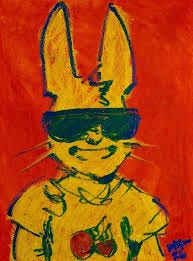
Guillory understands this transience, and rather than avoiding it, she embraces it by capturing these fickle social spaces. When Guillory paints virtual spaces, she is not painting a natural landscape or the face of a real individual; she is rendering a genuine person’s chosen avatar or a carefully crafted ideal environment. The person behind the screen has chosen this avatar or space to reveal an aspect of their reality. This intersection among user, avatar, and artist creates fascinating works of art that document the intriguing third space of the social internet.
In a traditional studio, people come as they are, only able to apply makeup or wear decadent clothes to alter their appearance. In VR, the subject creates or chooses their 3d avatar. There is an entirely different level of personalization, as one can present themselves as tall or short, a man or a woman, an animal, a fictional character, or even a meme. When Guillory paints a VR player’s portrait, she captures a chosen identity that is then transferred to reality through paint and brush.
Guillory’s VR portrait painting becomes a form of performance art in her series “Cross-Reality Studio Visits,” in which she records herself depicting avatars in her physical studio while blindfolded by her VR headset. The subjects enter an instance that looks extremely similar to Guillory’s real-life studio, and are allowed to share the intimacy of a muse-artist relationship despite possibly being hundreds of miles apart. While painting, Guillory converses with her sitter to best depict their chosen digital persona, making the portrait more than just a static copy of a 3D model.
Cyberspace as Canvas
The Paris Salon was the epicenter of Western art history for over two centuries. The semi-annual event became the only realistic way for an artist to support themselves through their art fully. They would converse with wealthy patrons, compare their art with that of other giants in the industry, and gain international recognition. Once a jury system was implemented, conservatism and elitism grew within the Salon, causing even the select artists who could afford the journey to Paris to be rejected for failing to follow standard painting practices.
The Salon was a historic canvas, providing opportunity for the most famous artists of all time to exhibit their work and receive funding to create even more significant masterpieces. However, this public exhibition was inaccessible to most artists of the 18th and 19th centuries. An artist must have had years of formal academic training and be sure to adhere to the Eurocentric hierarchy of genres, which places history paintings well above still lifes or landscapes.
Immersivism circumvents any traditional institutional gatekeeping, presenting art from any medium and any skill level. Spaces like gouache painter and Immersive artist Oz Pearsall’s “The Strange Pear” VRChat art gallery are the antithesis of the strict bureaucracy of the Salon. This gallery hosts monthly exhibitions, special shows, and lectures, while artists from around the world can converge into one space and discuss their work and sell physical commissions. “The Strange Pear” played a key role in the formalization of the Immersivist movement. On August 3, 2024, Guillory delivered a speech to artists in the server about the necessity of naming the emerging virtual art movement; thus, Immersivism was born.
“The internet is our wall space, so we put up our art wherever we want to.” (K. Guillory)
By turning cyberspace into a canvas, Immersivism removes the physical walls of the traditional gallery. Exhibitions are no longer limited to brick-and-mortar buildings in major metropolitan hubs. To formalize this decentralized model, Guillory and her peers established The Museum of Immersivism. Operating across multiple virtual world instances, the museum serves as both an open exhibition venue and a research facility.
Guillory has been intensely advocating for the legitimization of Immersivism as an art genre, teaching blind contouring techniques to fellow virtual artists at The Museum of Immersivism. Once the movement is more self-sustaining, she plans to step back from organizing and dive back into her horror and blind-contour art. (You can follow her work at kgpaints.net)
Outside of Immersivism, Guillory’s recent creative focus has been on narrative comic work as seen in her comic “CLOUT” (a snippet of which can be read here). Additionally, Guillory will likely continue her work as a freelance writer, focusing on VR, virtual design, gaming trends, and digital subcultures (much of which can be found on The Metaculture).
Throughout history, art movements have reflected the technological and cultural shifts of their era. Just as 19th-century Impressionists stepped outside their studios to capture fleeting light in an industrializing world, Immersivists step into headsets and virtual grids to record human life in digital spaces. Through a “Trinity of Interaction,” Immersivism redefines what it means to create fine art in the 21st century.
Through K. Guillory’s pioneering cross-reality sittings and blind contour oil studies, the volatile world of servers and code meets the permanence of paint and canvas. As platforms update, links rot, and online worlds vanish overnight, Immersivism ensures that these virtual communities are not forgotten.
Thank you to K. Guillory for taking the time to meet with us and share their art with KAILON, to see more check out their website!
Edited by Hanna Villegas
