


I graduated from university in the summer of 2024. That’s a year and a half ago, now. Since then, I’ve been doing what most arts and humanities graduates do—working in hospitality, or another unfavourable job industry that just about pays the bills. Applying for seven jobs a day, hearing back from none, considering the possibility that I’m not destined for what I’ve just spent 30k in education on working towards, snowballing through the weeks with tunnel vision and realising that every day is the same when you’re not waltzing through a degree in something you actually enjoy. Those memories get wrecking-balled out of my brain when my third customer in five minutes asks me for an Americano with hot milk on the side.
I could feel myself spiralling; worse, I could feel myself resigning to this lifestyle. Day in, day out: get up, go to work, maybe go to the gym, come home, cook, shower, mindlessly consume a show or a book or a film. Go to bed early, do it all again the next day. Maybe see some friends at the weekend, or not, because my work rota is different from theirs, so I miss out on things. Rinse repeat.
I’m not trying to sound bitter, or trying to bum anyone out – I’m well aware that the 9-5 is a very normal, very accepted reality for the majority of working-age people. It works for a lot of people, too, letting them live happy, balanced lives. Granted, I do believe that our blind acceptance and contentment with the modern way of living is something we’ve been brainwashed into wanting by the contemporary capitalist world and its governments, but that’s another article for another time. I’m here to talk about something else.
Backtracking – I felt stuck. Lost. Hopeless. And what do twenty-somethings do when they’re thrust into the world of full-time work and realise that there needs to be more to life than making coffee for people you’ve never met? They go travelling. And that’s what I did.
The usual spots—South-East Asia, Australia, South America—they didn’t appeal to me, not as much as I’d hoped they would. I knew deep down that I was a homebody: I wouldn’t want to be gone for months and months, no matter how stuck I currently felt. Those places didn’t feel right, for now; maybe they would one day. Still, there was one country that had been sitting at the top of my wishlist for years. A country I’d kept saying, “I’m going there next year,” about for the last three years, a country I’d curated endless Pinterest boards around, looked at flight prices until my eyes crossed, and planned a hundred different routes across it, only to give myself a headache because there was just too much I wanted to see. In early 2025, I realised I had finally saved enough to go to the land of my graduated, unemployed dreams: Japan.
I know what you’re thinking. Japan’s tourism has boomed in the last five years, astronomically. Everyone knows at least one person who’s visited recently. I knew I wasn’t a minority. I knew I wasn’t special, choosing Japan over somewhere in South-East Asia, but all I could think about was being 13 and watching a video of my favourite YouTuber visiting Japan for the first time, how it blew my tiny, pre-pubescent mind. I had to go.
It took the better part of a year to organise my trip: I had booked a two-and-a-half-week tour with Gap 360, and from then on, my boyfriend would be meeting me in Osaka for us to do our own travelling. Six weeks in one country. It was a lot. I knew it was a lot; I had spent countless nights hunched over my laptop, booking hotels and excursions, and flights months in advance. The first part of my trip, the tour, was my first ever solo travelling experience. I was terrified.
After gaining an “okay” to unpaid leave from work, sorting out any entry requirements, buying the obligatory travelling rucksack (Osprey, 55L, turquoise), and messaging a few of the other tour members online, I was as ready as I’d ever be. I left my anxiety in my childhood bedroom and set off for Heathrow in the back of my parents’ car.
Only for my flight to Hong Kong to be delayed by seven hours.
With seven hours of sitting in Heathrow airport alone ahead of me, I bid my parents a teary goodbye, and that’s when it hit me. From here on out, I was on my own. I’m 24 years old, and for the first time, I’m doing something entirely on my own, completely out of my comfort zone, because if I didn’t do it now, when would I?
I hate the narrative that people in their twenties feel like they’re running out of time, because as much as I try to reject that feeling, claiming that I have all the time in the world, it doesn’t feel true. It won’t feel true, probably, until I’m on the other side of my twenties, and I look back and realise, oh, everything turned out okay. Still, at this point in time, I was slap bang in the middle of my twenties crisis, and Japan, apparently, was my only salvation.
My first ever proper long-distance flight felt like being stuck in purgatory, like a journey out of time, which I guess it is in a way. I was travelling for roughly 24 hours: from Heathrow, to Hong Kong, to Tokyo. It felt longer than that and also like no time at all. Thankfully, once on the plane and waving a dreary England goodbye, I was plied with all the snacks, films, books, in-flight meals, and complimentary blankets I would need because I knew sleep wouldn’t be coming easily to me.
By the time I actually arrived in Japan, stumbled through the Haneda immigration queues, and fell into the taxi that would deliver me to my hostel, it was the dead of night. Stepping into this new country, sleep-deprived, smelling like an airplane, delirious, and craving a bed but also unable to tear my eyes away from the window as I watched the City of Tokyo pass me by in the back of a taxi for the first time.
It’s a feeling I can’t quite explain. None of the glamorous bits had been revealed yet, just the area of a city that always surrounds an airport in a perimeter - motorways, outer neighbourhoods, business hotels and industrial parks, passing me by in a blur. But when I stepped out of that taxi into the streets of peaceful Ueno at midnight, something shifted in my consciousness. I was in Japan. For all I knew up to that point, I could’ve been anywhere on Earth.
I practically floated across the road from the taxi to the front door with my luggage, checked in, snuck through a pitch-black room of snoring men, found my bunk, showered, and collapsed into bed. I felt tears brewing from the overwhelm of it all, and pushed them away. It didn’t feel like I was in the city of my dreams, but I was. Sleep came quickly, my mind taking comfort in the fact that despite being whole oceans away and eight hours apart, my loved ones and I were all under the same sky. I would be okay, whatever happened in the morning.
The next day, at about 11 am, I ventured onto the streets of Tokyo for the official, first time, alone.
It was much, much warmer than I was expecting for early October.
A little shell-shocked, I entered my destination into Google Maps and began my wander, stopping at a Lawson on the way, of course, walking aimlessly round the tiny aisles in a daze, picking up snacks and drinks I’d only seen through TikToks of ‘If you’re in Japan, you have to try…’. I think it’s good on your first few days in a new place not to have much of a plan in mind - maybe one sight nearby that you fancy seeing, a little list of things you need to buy, something you’d like to try for lunch. It leaves you with plenty of room for the most important activity in a new place: exploring. And that’s what I did.
Walking down quiet Ueno side-streets instead of going headfirst into the chaos of somewhere like Shibuya, I felt like Tokyo was introducing itself to me, slowly, with the chirping of crossing signals, wind chimes in shop fronts, cars passing slowly and a crow muttering to itself from a telephone pole. I walked across the infamous Kappabashi Street without even realising, marvelling at the endless rows of independent cookware shops and wondering why there were mascots of Kappa’s all over this specific street.
I reached Senso-Ji after an obligatory stop at Uniqlo, and was floored. Quite literally, speechless. Because how could something like this be here, in the middle of this endless metropolis of a City? I couldn’t comprehend it. There were people everywhere, from all walks of life, taking pictures and learning, and all looking a little in awe like me, and we were all diminished to ants in the face of this beautiful evidence of a Japan long past, still standing proud now.
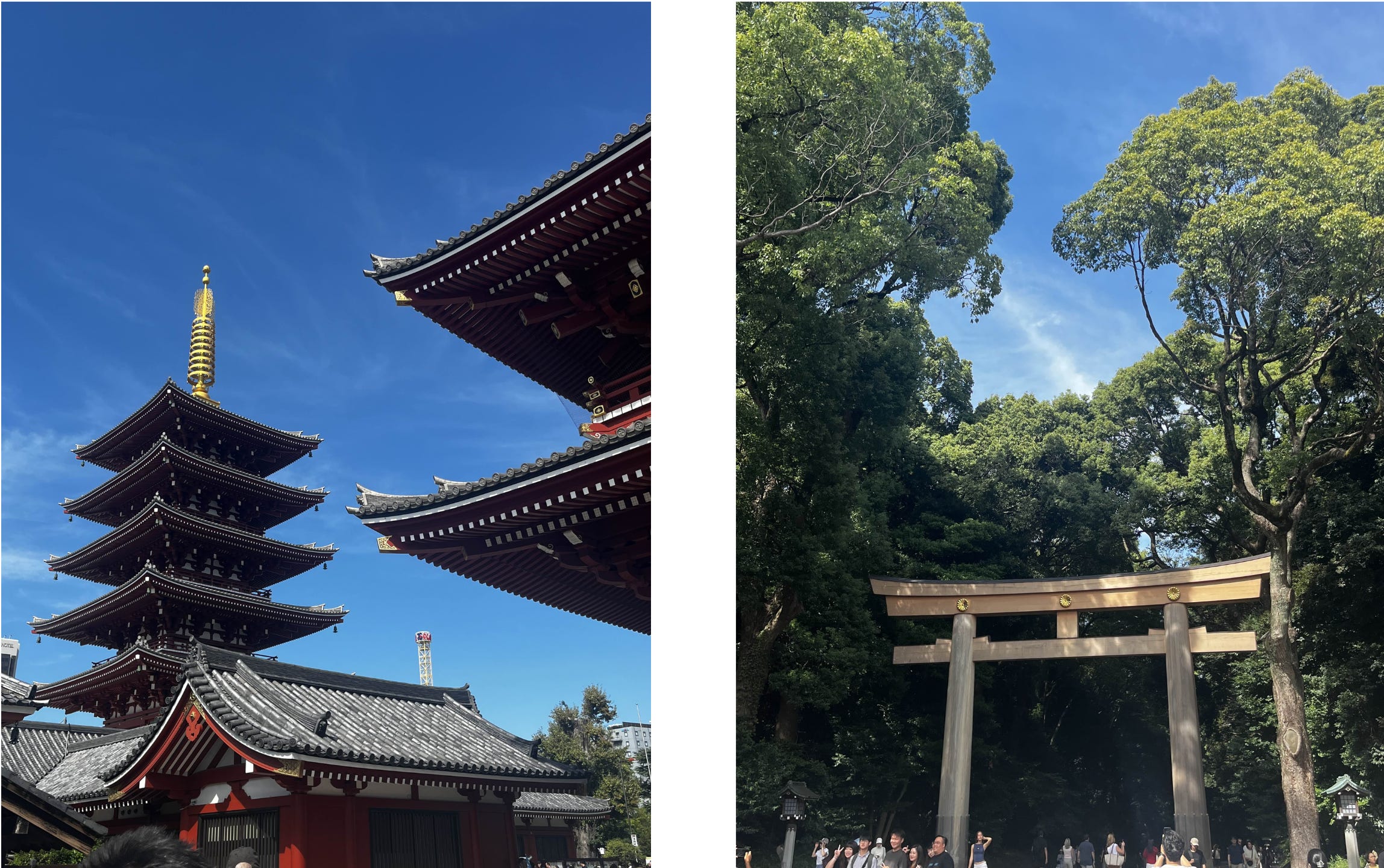
Lunch; I went into another konbini (7-11, this time), bought my first of many tuna mayo Onigiris, and strolled back towards Ueno Koen, dwarfed by trees of shimmering emerald instead of the burning red of momiji’s I was expecting; leaves of golden brown already coated the pavements back home. I sat by a huge fountain, delighted like a little kid by its simple water display, soaking in the unexpected sunshine, watching Tokyo pass me by. And I almost caught myself crying again, because how was this real? How was I here, after all this time? I’d never felt so free.
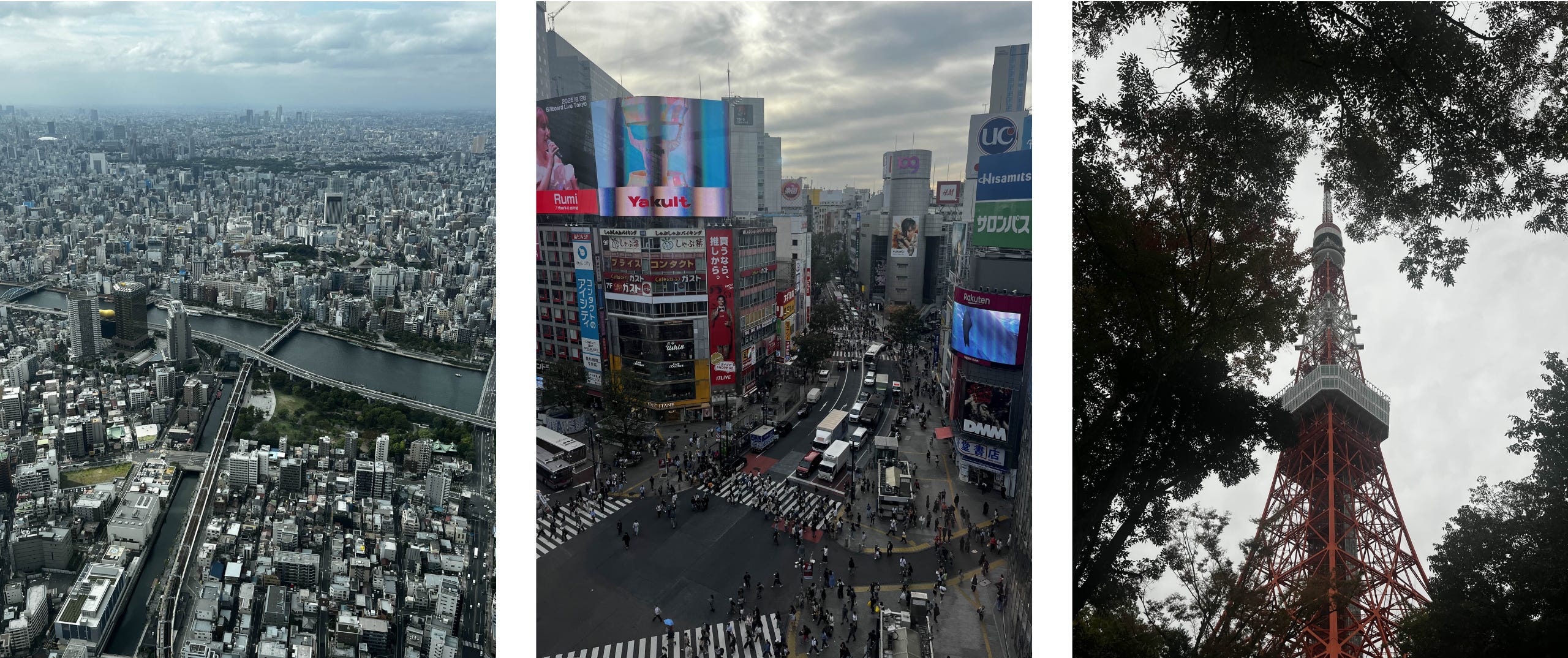
I did Tokyo twice - at the beginning and the end of my trip. Going back to it that second time, it felt full circle, familiar, almost like coming home. Every area of Tokyo I visited felt like a different area within a video game, all connected but offering different quests and sights for your eyes and brain and soul—even saying this, I barely scratched the surface. Ueno, my first taste of Tokyo, and its ability for peace versus the neon chaos of Shinjuku. The Times Square of Japan, Shibuya, versus the fashion utopia that is Harajuku, only a subway stop apart but entirely different and equally spectacular. I find it hard to summarise just Tokyo in one paragraph, because there’s still so many places I visited across the country that I want to tell you about, but I’ll try.
Tokyo is a city of hundred-year-old temples sitting side by side with claw machine arcades and maid cafes. Tokyo is a City from the future, a glittering, pulsing, looming maze of anything you could think of, the beating heart of a country whose landscape just a train ride away from the centre, feels like a different world entirely. Everywhere is overflowing with people, all caught in the web of billboards, anime, matcha, fashion, and consuming, consuming, consuming. Cheap konbini drinks and fried food, stumbling through the streets after the last train, everything blurring and flashing, and you’re grinning like you’re in adult Disneyland.
Wash the late-night karaoke fuzziness away with a temple visit or two. Collect the stamp whilst you’re there, a charm bought for the loved ones back home. Visiting a viewpoint and feeling like you’re looking down on the entire world, and also realising, from above, all cities look the same: grey, infinite, suffocating. Getting the tube home, nodding your head to the happy little jingle it plays at each stop, playing pretend at living here, unaware that, of course, it’s not all as it seems. But you wouldn’t change it for the world.
I was in Japan for six weeks, so of course I saw more than just Tokyo. I would recommend one thing to anyone thinking of visiting this gorgeous country: go off peak. People do it a disservice by visiting just Tokyo, Kyoto, Osaka, and then complain when it’s too busy, not authentic enough. Here are my thoughts on a few of my favourite places that I visited.
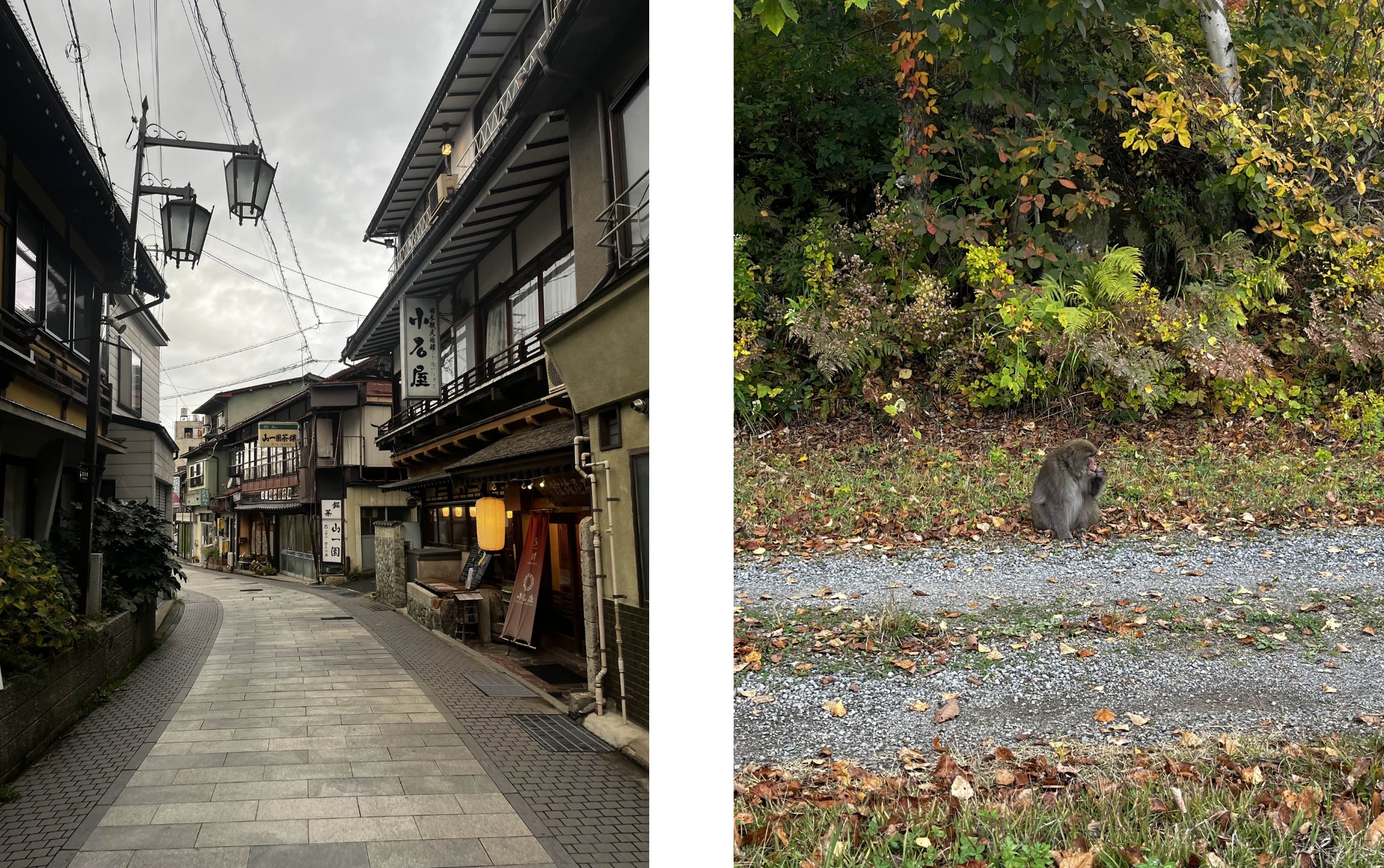
Two hours away from Tokyo: Nagano, but it could be a different planet compared to the sprawling City you’ve just come from. Crawling up the misty mountains to a town called Shibu Onsen, everything falls away—skyscrapers, dive bars, pop culture. This place is a different beast: a tiny ‘high street’, lined with not shops or arcades, but hot baths. Corners of total relaxation, inner peace, if you can brave getting naked in front of strangers. Which is really the most natural thing in the world, at the end of the day. Seeing the infamous wild snow monkeys, rare and native to just that area of Japan, not in their usual park, but on the side of the road, sitting patiently, like they were there waiting for you.
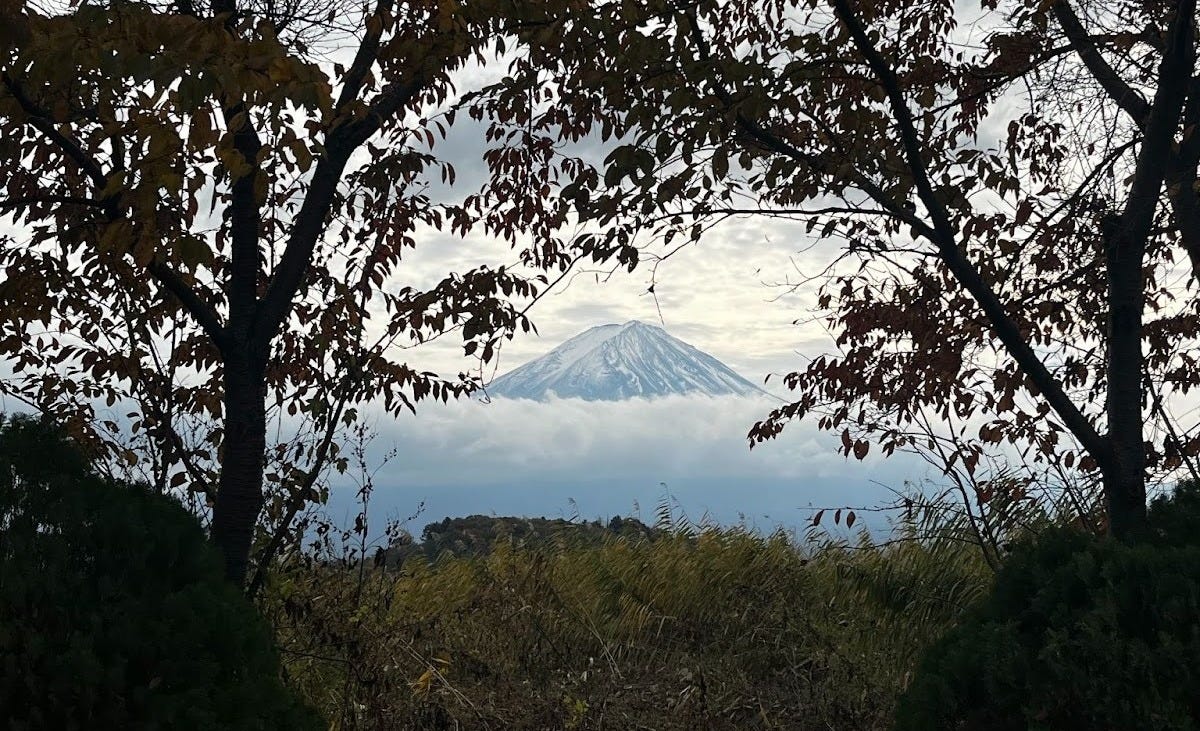
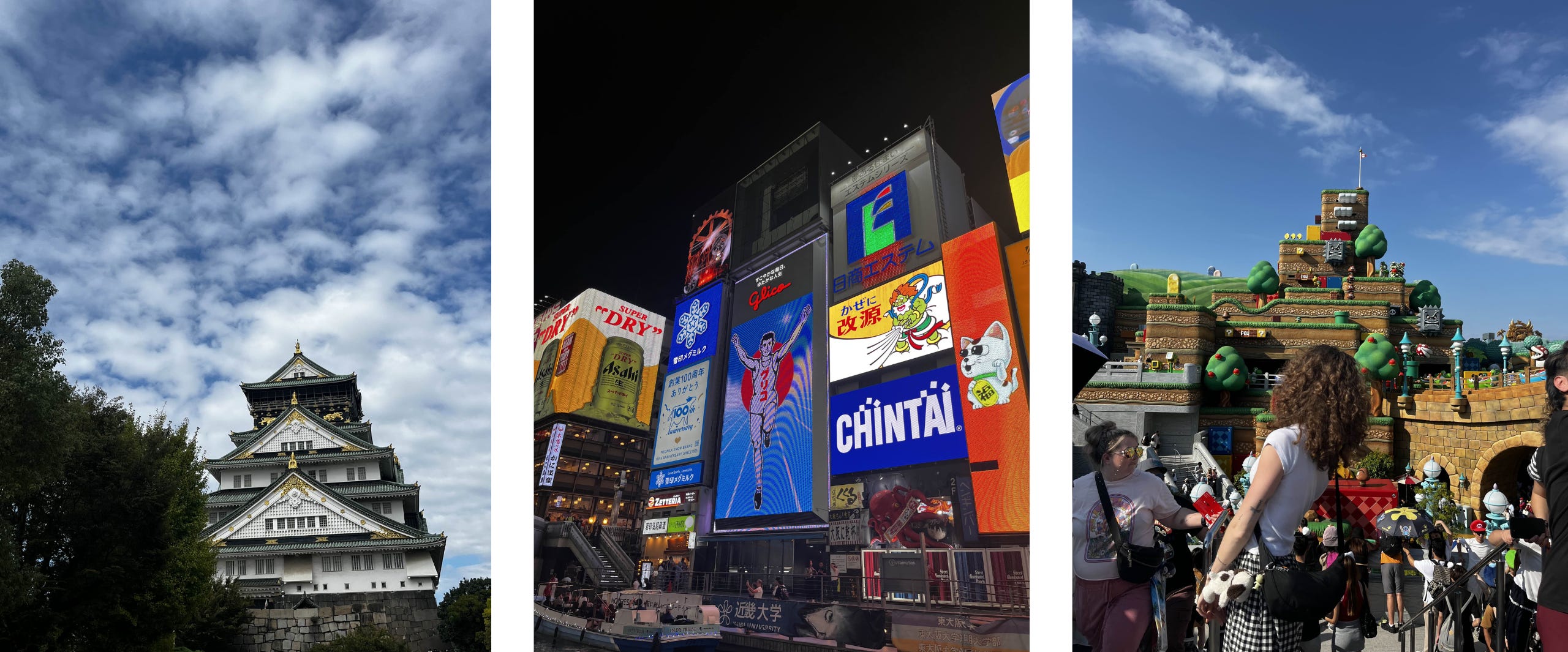
Mt. Fuji is surrounded by little pockets of civilization in a circle, like they were all built with her in mind, as their orbit. All I can think whilst driving around this area is: people live here? People go about their day-to-day lives, the world passing them by, with a view like that? It seems unfathomable. Convincing yourself that you won’t see her - and when you do, not once but twice, it feels that much more magical, like seeing a real-life unicorn. Perhaps the most notable town, Hakone: a street made up of cafes and hotels and museums, all centred around a tiny train station. The evening before you saw Fuji-San, you remember running up a massive hill at sunset with friends to reach a destination of pizza and wine, laughing and wheezing and just feeling so alive. The magic of this area feels like Fuji herself cast a little spell of peace over it, protected and wondrous.
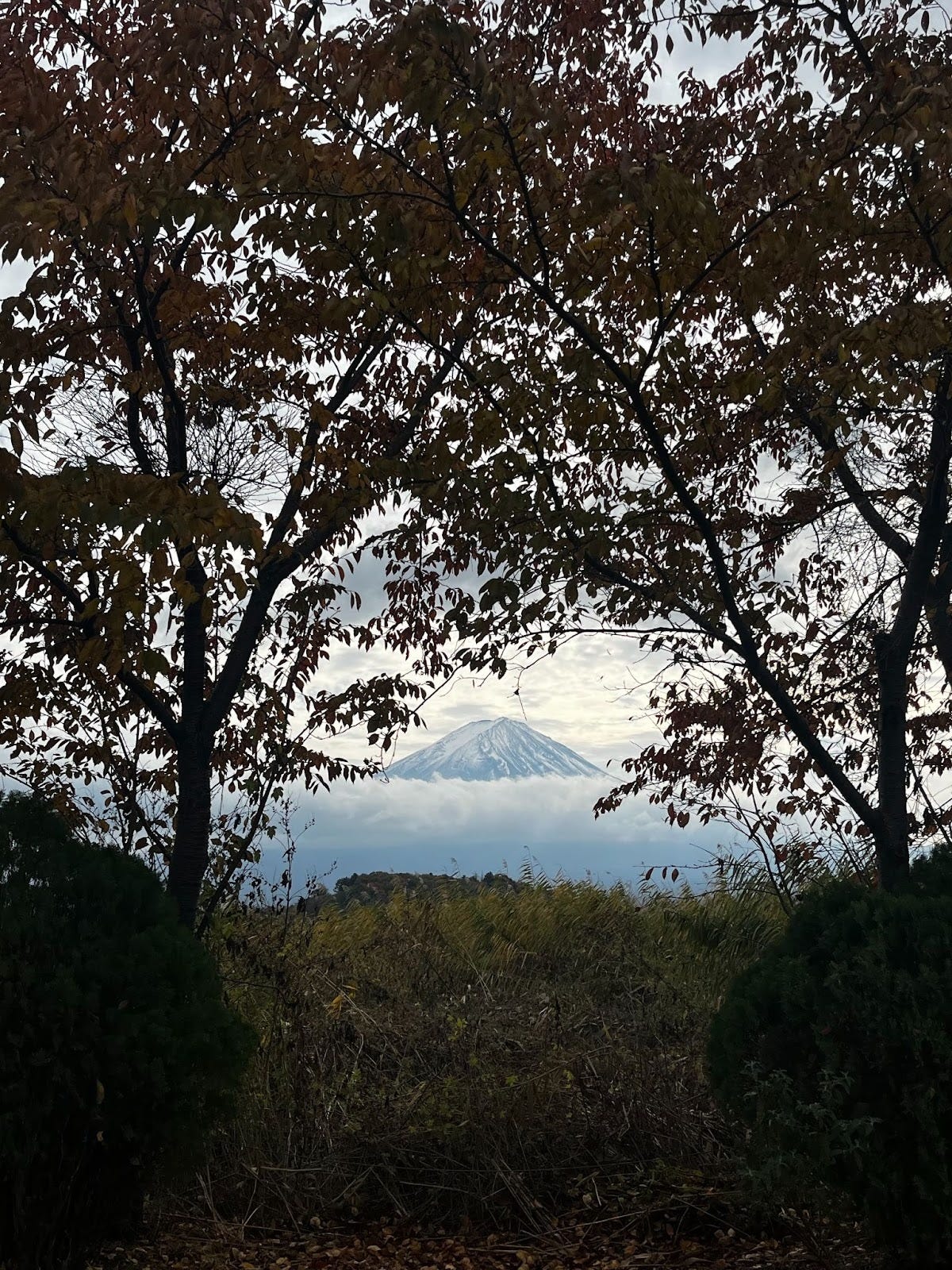
If you have the time during your trip, I urge you to explore as far South in Japan as you can. I didn’t get particularly far, but what I did see was unlike anything I saw anywhere else on the trip. If you’re into your cycle rides, I recommend doing the Shimanami Kaido across the Geiyo Islands: two days (or a day if you’re determined!) of island hopping by bike through the Seto Inland Sea, just off of Hiroshima. My boyfriend and I did this at the end of October, and despite it being very physically demanding, it was all warm breezes and blue skies, birds of prey and herons flying alongside us for the journey, and pit stops in the most quaint of seaside towns. Crossing bridges that spanned the ocean, feeling like you’re cycling through the sky. An utter dream and a whole world away from places like Tokyo and Osaka. Just watch out for the Golden Orb Weavers!
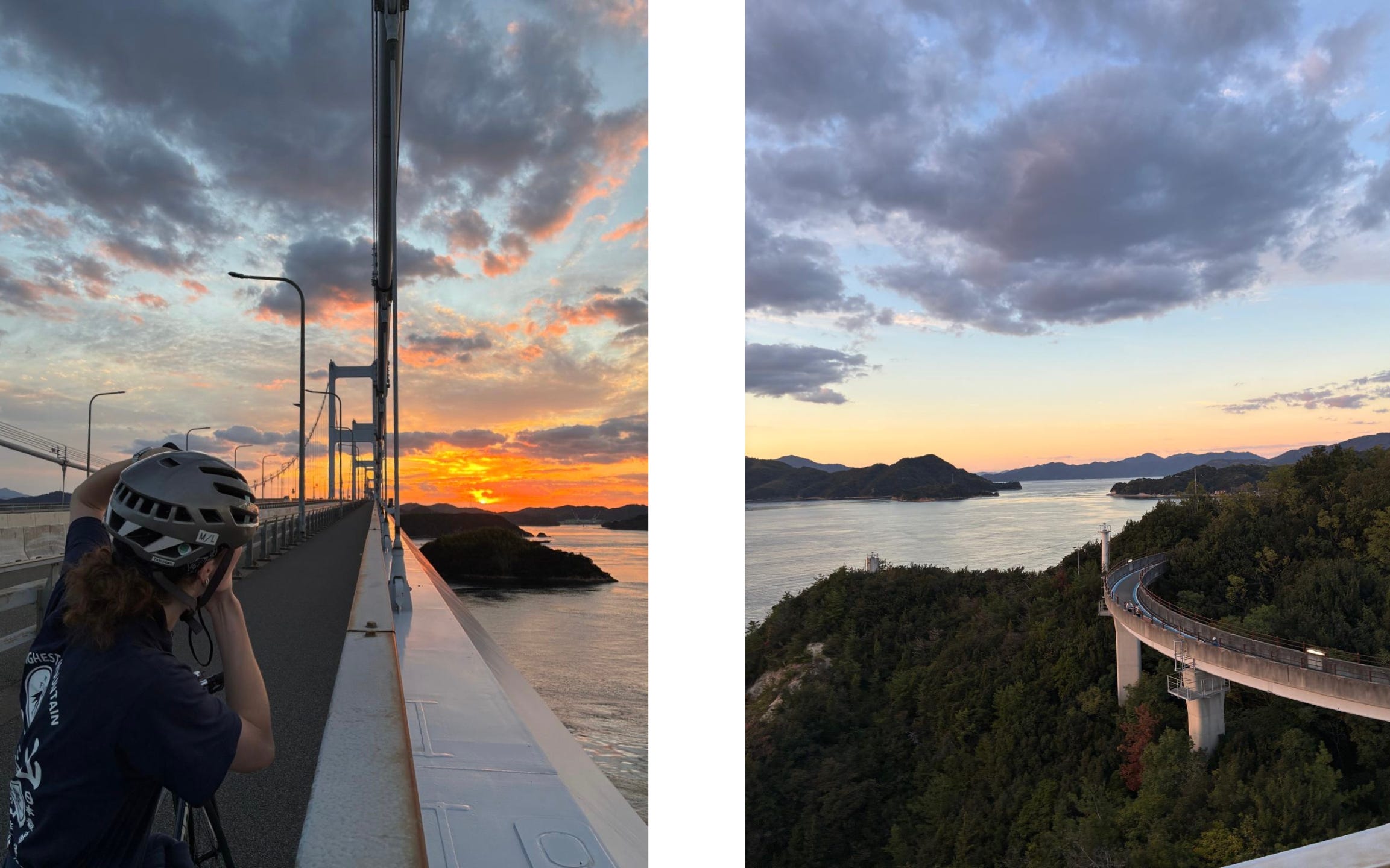
Steeped in history, mythology, and religion, all three twisting together in the mists to create a town nestled amongst the Kii mountains that feels like a portal into a bygone era: Koyasan. A handful of temples, each home to monks, living their lives in time with the turning of the Earth, utterly at peace. Our group stayed in Ekoin Temple, living alongside Buddhist monks for two days - an eye-opening experience, and a lifestyle wholly different from what all of us were used to. A town that has more temples and shrines than it does houses, supermarkets, and cafes. Whilst staying here, I walked through one of the biggest cemeteries in the world, Okunoin cemetery, in the dead of night; a genuinely terrifying experience. Not in the typical fearful way, but because you can feel spirits from beyond walking with you, watching you. I’m not a spiritual person, really, but this town is one of the few places on Earth that I feel the curtain between our world and beyond is definitely more transparent. And you get used to it, and it’s utterly peaceful, once you let that feeling in. You will take away a little slice of this lifestyle into your own way of living, forever. Maybe not the hours of uninterrupted meditation, though.
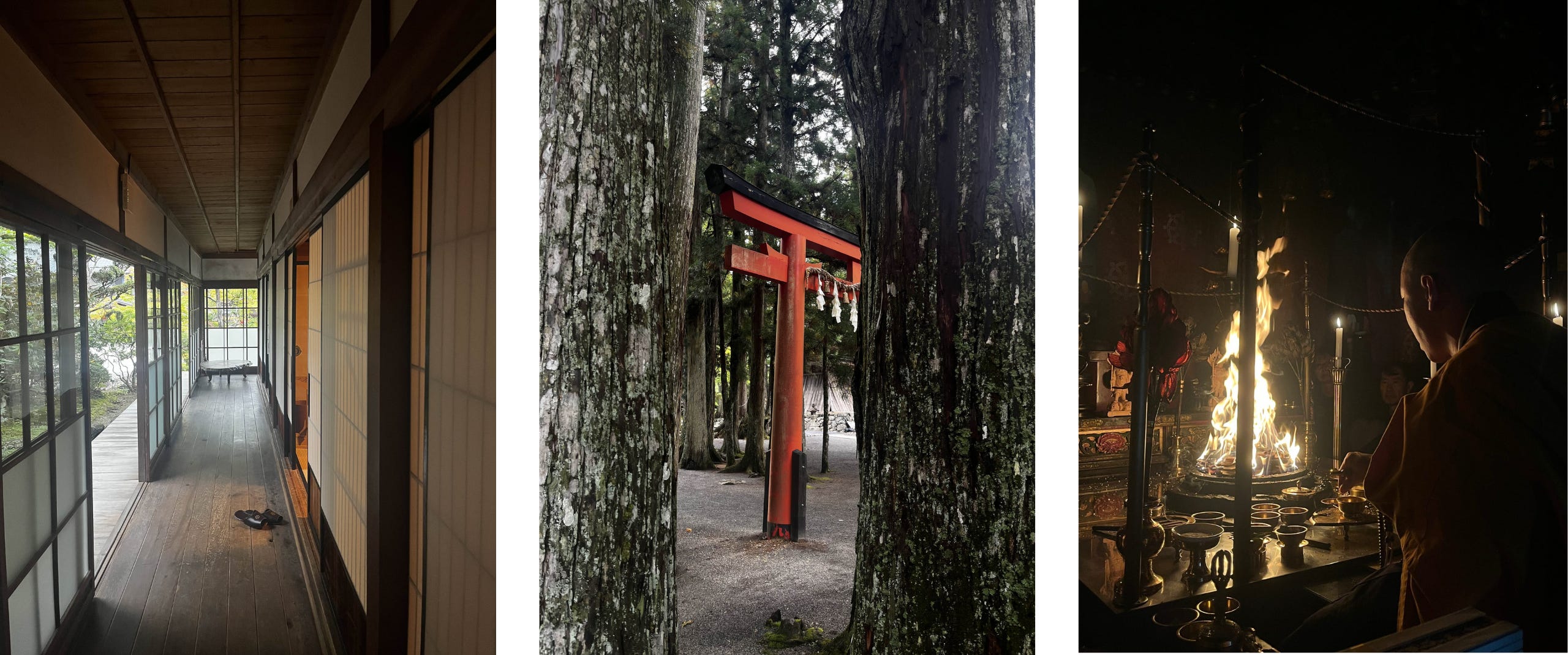
I said above not just to do the three big cities, but they also absolutely cannot be missed. Osaka: A pleasant surprise. A city of a size that feels navigable, that feels familiar to you. To me, it was like a suburb of London, walkable, the best shopping, its own unique flavour of style that is intimidating and welcoming at the same time. So much to taste, to see, to try! Osaka feels like a theme park, a fairground with that gleaming, sky-reflecting canal running through the middle of it like black treacle. Somewhere in the middle of the city sits Universal, an actual theme park, and from high up, train rides, you can spot a Hogwarts castle turret, a Nintendo-green warp pipe, and a mushroom or two. Fantasy lands made real. Winding streets of octopus treats and vintage stores and people who are just so effortlessly cool and live in maybe the coolest city in Japan, and they know it.
And then, a short journey by Shinkansen to Kyoto. Utter bliss, and probably my favourite place I visited on my trip, second only to the Geiyo Islands. If you can, spend as long here as you would in Tokyo. There is just so much history to be experienced. This City is a bizarre combination of modern-day high streets and Edo-period alleys and districts, and yet it works so well. Crossing Shijo bridge every day and marveling at the river you’re walking over, a little like the bridge in “Spirited Away”, crossing from the new into the old. Walking down the same streets as geishas, sharing your day-to-day with ancient traditions.
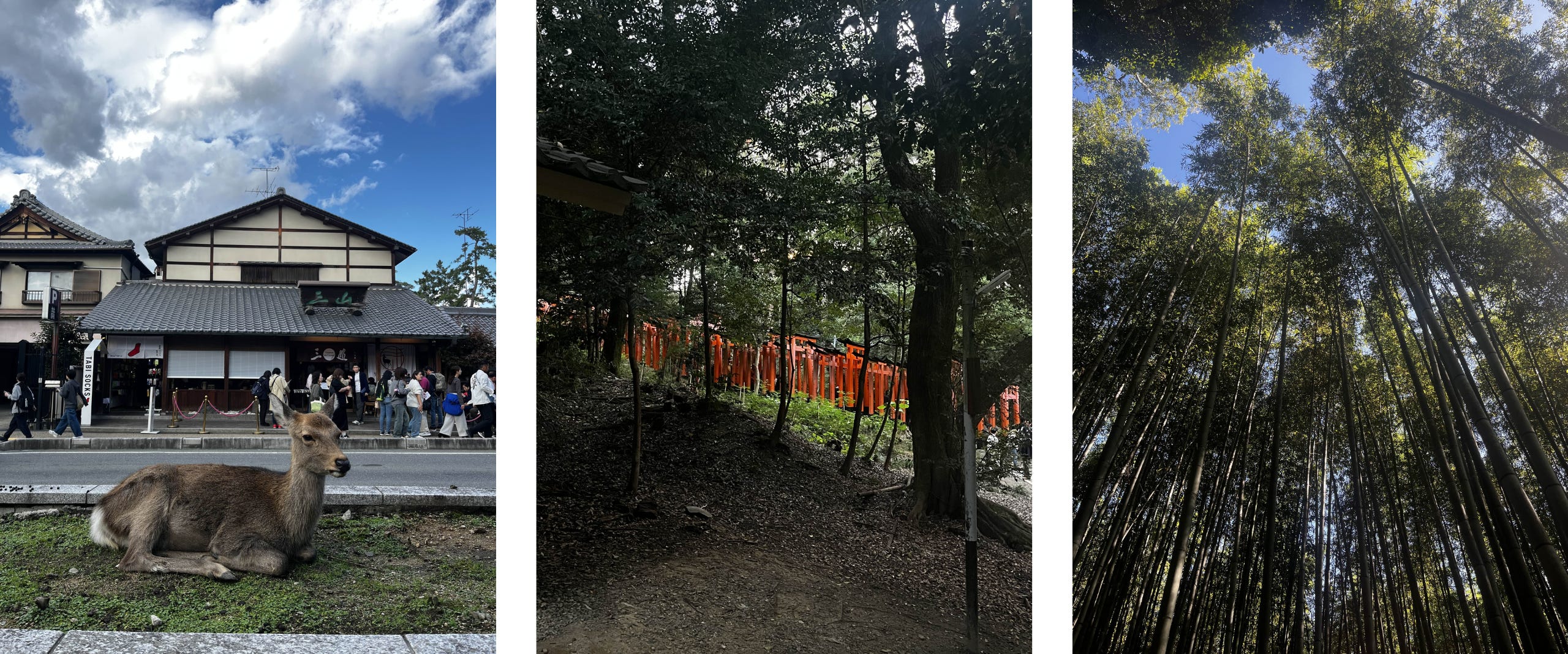
In Kyoto, I held a thousand-year-old katana in my hands on the same day I went vintage shopping down Teramachi Street - there really are endless adventures waiting for you here if you know where to look for them. A melody of twinkling glass chimes and biwas and wind drifting through bamboo wherever you go; this is Japan, you realise. Or at least, the most Japanese-Japan that it will allow the majority of tourists to see. Sharing your lunch with deer in Nara (willingly or not), walking under trees with leaves the same rich-red colour as ancient Torii gates, filling your veins with matcha, and eating everything you can get your hands on because it’s all new and a trip for your taste buds and weird and delicious. Walking the philosopher’s path, a non-negotiable on my list, and feeling a touch of peace that the great minds must have felt. Kyoto is a City that changed my worldview for good, not for the better or worse, but permanently shifted it. It will stay nestled in my heart for a long time to come.
It’s hard not to go to Japan and romanticise it. Or say, ‘I could move here.’ It’s not one big theme park - everyday life is like most other first-world countries, if not a little more convenient on a day-to-day scale. Catch the expressions of Japanese citizens on your rush-hour tube journey to dinner or another sightseeing destination. Everyone’s on their phones or staring into space. Exhausted, overworked. Not dissimilar to any other big city commute, really, but the work culture in Japan is brutal, especially in Tokyo.
It’s not somewhere that’s going to solve all your problems—it has its own to worry about. This hit me about halfway through my trip. I realised I’d be going home eventually, that this wasn’t forever. All the problems I’d been putting off—my job, my career, moving out, moving away, what I was doing with my life—were all waiting to hit me like a sledgehammer. Gallivanting across Japan didn’t heal me; I still had problems waiting for me at home. But I will admit, this trip did change me for the better. Left me with happy memories, left me a little more clear-headed, keen to explore more, see more of the world.
I won’t act like I know it all; I’m 24 years old, still living at home, writing this from my childhood bedroom, and sorely missing the country I’ve just written an article on, or just the feeling of being abroad, for that matter. I’m painfully aware of how young I still am, how little I’ve seen, how little I know, and how much I have left to learn. I wanted to replicate a little of the indescribable feeling I had exploring a country that was new for me, and how vital it is to do this, at least once. If you have the means and the money and nothing is stopping you, go. Go abroad, go and see the world, wherever you’re from. Even if it’s just one country, make it count. You might find your way back onto the path you’ve been fighting to search for.
Edited by Grace Myatt
All photos provided by Lottie Bowden
