


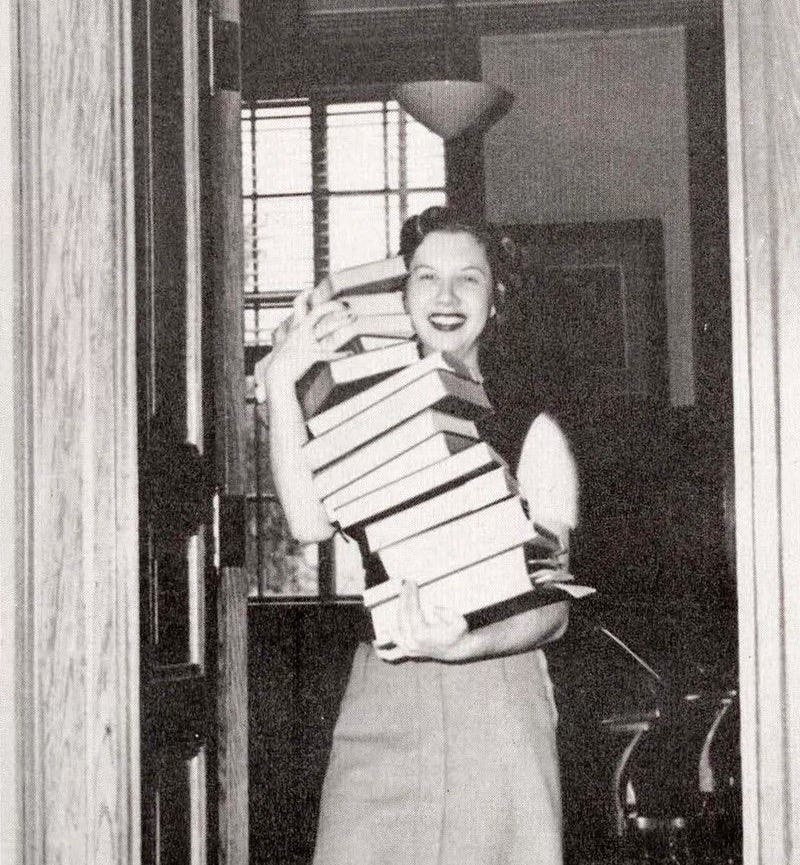
When I was a child, my dream was to be an author. I was always writing, always reading. I lived and breathed books, and vowed to myself that I would get to write for a living, to make my ultimate hobby a career. It didn’t seem like many other people shared this dream, or if they did, they kept it to themselves, scared of being condescended, being told ‘be realistic’, to have a backup plan when this dream inevitably didn’t work out. As I’ve grown, I haven’t quite achieved that dream just yet. But it’s still there, still flowering, nestled amongst my day job and my pile of favourite books and these articles I post online for ten people to read. Anyone can write a book, and of course, it’s important to never lose sight of your dreams.
Yes, anyone can write a book; that has always been true. Whether or not it gets published is another matter, but quite literally anyone can put a pen to paper and write a novel if they put their mind to it. And now, people are doing that, and almost all of them, it feels, are getting published. Maybe not everyone; just the handful of influencers that already have follower counts in the hundreds of thousands, and who now have the means (and the money) to try their hand at a source of income a little more…intellectual.
When did publishing become so easy? Should it be this easy? I feel as though every time I walk into a Waterstones, there are five new romantasy novels on the central display table, all with similar covers and fonts, all renditions of stories we’ve heard over and over, and at least two of them are written by names I recognise from TikTok. Maybe I feel a little pang of jealousy each time someone crops up on my feed with a gushing video about how they’ve become a debut author within less than a year - but a bigger part of me is just confused. How are people doing this?
As far as I heard, being a published author was an achievement of the highest esteem. Writing your debut novel for years, spending money on it you didn’t know you had, toiling and working so hard for it all to come together and shoot you into literary stardom, finally. Now it feels like something anyone can do, which is a good thing in terms of accessibility, but not so much for quality control.
Because yes, anyone can write a book. But that doesn’t mean that everyone should.
-
It’s excellent that in the modern world, thanks to the digital age, publishing has become more accessible and affordable for all. Talented voices that would have otherwise gone unheard can now post their work for the masses, gain traction and visibility for their novel that may not even be published yet. And when it does come to that, websites like Amazon Kindle Direct Publishing (Amazon KDP) make it easy for a debut author to put their book up for sale online. Whilst this technology is utterly revolutionary in the world of publishing, I don’t think we should be selling our manuscripts to Big Tech conglomerates such as Amazon. But I will admit that the company has provided a good starting point for budding authors to get their work out into the world, all bug and bot issues aside.
Publishing has always felt like this impenetrable, upper-class industry that people with no connections have no hopes of breaking into, but now self-publishing and online publishing offer people, who wouldn’t otherwise have the chance, an opportunity to get their work seen. It creates a more diverse playing field in an otherwise biased industry and brings fresh, young authors’ names into the spotlight, providing opportunity for new talent instead of showcasing the same writing names that turn out five novels of the same genre a year. Amazon KDP may not offer much in-house marketing itself, but the majority of people who are uploading their novels to the site are also putting in the work elsewhere: social media. In the new age of press tours, authors can post as many Tiktoks, Instagram dumps, and Twitter threads about their novel, at no cost and minimal effort, gaining the attention of thousands of like-minded individuals online if they know how to do it right. So basically, you’re cutting out all the outrageous costs of hiring professionals to do all of this for you - you can do it yourself, if you’re willing to put in the work!
This take on traditional publishing is naturally best suited for people who aren’t in it for the money, because, realistically, self-publishing is not something that you do to make millions. That’s why the professionals are so expensive. I feel that self-publishing is for people who are just starting, or more evidently, just want their work to be out in the world, for it to be read and enjoyed. And at the end of the day, that’s the most important part of writing - you do it because you love it.
-
Everything I’ve said above is true, but there’s definitely a darker side to self-publishing coming to light in more recent years. Not just self-publishing, but this entirely new ecosystem that’s been thrust upon the literary world with the rise of social media.
I’m talking primarily about Booktok. What started as a way to share which books you like with others, to see what others were reading, and to be part of a bookish community you may not have had before, Booktok has now evolved into an entirely different beast. Every single bookshop now has a table or more dedicated entirely to ‘booktok recommendations’, so basically, whatever’s trending online that week. Certain booktok influencers’ opinions are treated as gospel, only for them to be cast aside a week later due to controversy and messy parasocial relationships with other influencers. With every trending romantasy novel, a new TV or film deal gets signed, and another original film idea gets shelved. Book deals for all! And that would be fine, if all of these novels were well written, unique, commenting on new and interesting ideas. But the majority of them aren’t. The majority are poorly thought out romantasy novels with the same structure, centred around a strong willed but essentially feeble female main character who gets swept into the arms of the brooding male love interest, for them both to save the world of X, defeat the evil clan of X, and fly off into the sunset of their new kingdom with their newly wed titles on the back of their flying X. Sound familiar? A little too familiar perhaps?
One of the main causes of this major surge in sub-par fantasy literature, and something that is becoming increasingly common and increasingly worrying within the publishing industry, is popular fanfictions from massive fandoms getting turned into novels, and I think this is where the biggest issue with the rise of romantasy specifically lies in terms of quality writing. Whilst I think it’s ironic that a subsection of fandom culture that I was actively a part of and shamed for in my teen years is now being used on a worldwide scale to make money and marketed to the millions, I also think it’s a form of blatant plagiarism. To take a novel that has been published online under an alias, for fan-made entertainment purposes, and to then edit that piece of work a little, change the names, and publish it as its own ‘original’ work, doesn’t take away from the fact that it was originally a fanfiction about Hermione and Draco from Harry Potter. It is someone else’s work, their masterpiece, their worldbuilding, and their characters, just glossed over with poor-quality paint and a different title. It doesn’t feel entirely legal. And it’s worth mentioning that it’s not the best of the best fanfictions being published, that genuinely talented writers aren’t getting their dues. Because, in the words of roseworth from Tumblr: “The best fanfics can never be published as an actual book because it’s intricately woven into the canon material, so it’s inseparable even if you change the names.”
I’m not at all calling fanfiction authors bad writers - quite the opposite. But it’s becoming an increasingly common trend that people are using pre-established universes with large fandoms to write fanfiction as a means of getting their own book published: their own half-baked ideas mixed in with a world that’s already been built for them. And that’s how we end up with novels coming out each year where all the source material is the same, all attached to the names of ‘Booktok influencers’, not many of them particularly well written, and all of one particular genre of story catered solely for the young female adult demographic who have been following the writing process of this story for months already on Tiktok. Not to mention the rise in the use of AI to assist in ghostwriting novels, therefore leading to work that isn’t just poorly written, but also not even human. Because of this, it’s becoming trickier for real writers to come up with original work without being compared; the most recent example being people online comparing Powerless (Roberts, 2023) and Red Queen (Aveyard, 2015), claiming the latter plagiarises the story of the former, despite Red Queen being written and released almost a decade prior. And now, with a book adaptation of ‘All The Young Dudes’, perhaps the most popular Harry Potter fanfiction ever written, being picked up, it’s hard to visualise how a novel of a novel of the most famous film franchise ever, is going to be played off as a semi-original work, or even mildly authentic as its own body of work.
This crossover between fan-made headcanons and literature universes that are already established is bleeding over into other mediums as well, mashing tropes and ‘cores’ and classic narratives together to make something that appeals to the online craving for aesthetics and hype. For example: How many people have read A Court of Thorns and Roses (Maas, 2015) vs. Wuthering Heights (Brontë, 1847)? How many people watched Wuthering Heights (Fennell, 2026) and claimed it was ‘for the book girlies’, when not a single part of the film was book-accurate? Fennell herself admitted that her vision for the film was ‘How she imagined the book in her head when she read it at 14’. So, quite literally, bringing your own fanfiction fantasies to life and making it your own by framing it as an adaptation. Wuthering Heights would’ve received far less backlash, I feel, if it had been its own original story, instead of trying to revive one of the most retold stories of all time. I don’t want to spend the rest of my life reading and watching remixes of the same stories over and over; I want something original.
It’s clear that the rising antagonism towards the romantasy genre is rooted in misogynistic ideas, and I don’t think this image is helped by what I’ve mentioned above - so many of the published novels within the romantasy genre are based on someone else’s idea, or feel like something straight off of Wattpad. But I think that’s missing the main point; reading something is better than not reading at all. Romantasy is a genre that’s getting people reading, people who maybe haven’t picked up a book in years. The idea that the genre is a form of ‘brainrot’ (compared to TikTok? Please.) is just the opinion of one person that is being bounced around the echo chamber of social media, another indicator that people are struggling to think for themselves with the rise of a digital society. Instead of focusing on what people are reading, the anti-intellectualism debate needs to focus on people who aren’t: primarily, the American far right. Anti-intellectualism has wormed its way into politics via the US President, and that is how he is currently staying on top, with misinformation and his followers being unable to think for themselves. That same thing is happening in many other countries all over the world as well. It’s not a coincidence.
It could be mentioned that maybe more people are writing books as an act of rebellion against the digital age (see my article on this here), but this rebellion feels nullified when said novel is so heavily catered towards an online audience’s tastes, and is marketed entirely online. This digitisation of literature and the discourse around it is contributing a big part towards people not forming their own opinions on not just literature but life, and it has rapidly hurtled towards a hive mind society in terms of arts and culture. If no one is writing anything original anymore, if everyone who’s making art is doing it just for the online discourse, then I fear we may be more doomed than we think. How can a society move forward and progress if all we’re doing is fixating on a culture that’s passed?
Sources (listed in order of appearance):
Amazon Kindle Direct Publishing (n.d.). [online]. Available from: https://kdp.amazon.com/en_US/.
Joanna (2025). A frustrated author’s tale of woe [online]. Available from: https://libertabooks.com/self-pub/amazon-kdp-a-frustrated-authors-tale-of-woe/.
roseworth (n.d.). [online]. Available from: https://www.tumblr.com/roseworth?source=share.
Roberts, L. (2023). Powerless. New York City: Simon & Schuster.
Aveyard, V. (2015). Red Queen. London: Orion Books.
Bowden, L. (2026). The Analogue Reset. Kailon Magazine [online]. 27 February. Available from: https://open.substack.com/pub/kailonmagazine/p/the-analogue-reset?utm_campaign=post-expanded-share&utm_medium=web.
Maas, S. (2015). A Court of Thorns and Roses. London: Bloomsbury.
Brontë, E. (1847). Wuthering Heights. London: Penguin Books.
Fennell, E. (2026). Wuthering Heights. [cinema]. USA: MRC.
Edited by Sonal Butley
